
Swiggy went public in November 2024 with a Rs 11,327 crore IPO, and it felt like half of India had an opinion about it. Some called it the next big thing in Indian tech investing. Others said you’re basically paying a premium to fund someone else’s food delivery losses. Both camps had a point.
Nearly 20 months later, the Swiggy share price tells a sobering story. A stock that debuted at Rs 420 with a 7.69% listing premium is now trading around Rs 241 – a 38% decline from its IPO price of Rs 390. The Swiggy vs Zomato debate has only intensified since.
This deep-dive covers the full Swiggy IPO timeline – GMP history, listing day performance, financial trajectory, the all-important Zomato comparison, and where the stock stands now. If you’ve been tracking the swiggy ipo gmp, looking for the swiggy ipo listing price, or just wondering what happened to the swiggy share price today, this is your complete guide.
Swiggy: India’s #2 Food Delivery Giant – Company Overview
Swiggy was founded in 2014 by BITS Pilani graduates Sriharsha Majety and Nandan Reddy. Originally incorporated as Bundl Technologies Private Limited, the company rebranded to Swiggy Private Limited in April 2024 and converted to a public limited company ahead of its IPO.
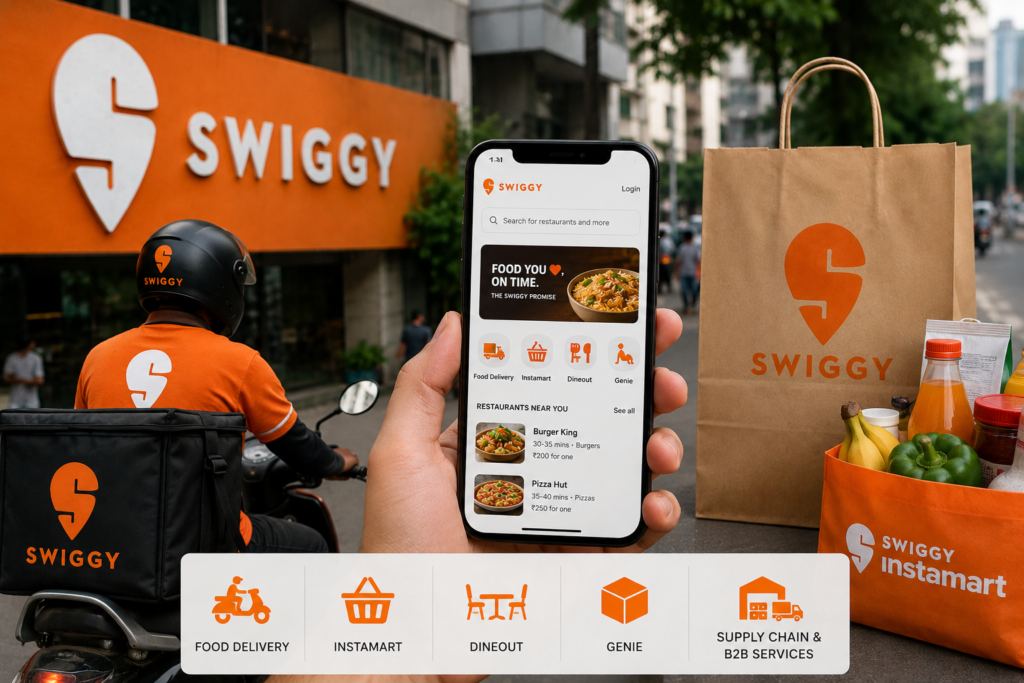
At its core, Swiggy is a consumer-first technology platform that operates across five business verticals. Food Delivery remains the bread and butter (pun intended). Instamart handles quick commerce for groceries and household items. Dineout covers restaurant reservations and dining. Swiggy Genie offers on-demand package delivery. And the company also runs supply chain and B2B distribution services.
As of June 2024, Swiggy operated 557 active dark stores across 32 cities for Instamart (expanded to 605 stores across 43 cities by September 2024). The company employed over 5,400 people and served millions of customers through its delivery partner network. The platform offered approximately 19,000 SKUs on Instamart alone.
Swiggy’s investor roster reads like a who’s who of global venture capital – SoftBank, Prosus (via MIH India Food Holdings), Accel, Alpha Wave Ventures, and Tencent Cloud Europe were all significant shareholders pre-IPO.
Source: Swiggy RHP; Chittorgarh.com; Swiggy Wikipedia
Swiggy IPO Details: Rs 11,327 Cr, Price Band Rs 371-390
The Swiggy IPO was a book-built issue worth Rs 11,327.43 crore. It comprised a fresh issue of 11.54 crore shares (raising Rs 4,499 crore) and an offer for sale of 17.51 crore shares (worth Rs 6,828.43 crore, with a face value of Re 1 each).
The price band was fixed at Rs 371 to Rs 390 per share. Minimum lot size was 38 shares, requiring a retail investment of Rs 14,820 at the upper band.
The IPO opened on November 6, 2024, and closed on November 8, 2024. Allotment was finalized on November 11, with listing on both BSE and NSE on November 13, 2024. Anchor investors committed a massive Rs 5,085.02 crore on November 5 – strong institutional conviction.
Among the OFS sellers were Accel India IV (Mauritius), Apoletto Asia, Alpha Wave Ventures, Inspired Elite Investments, Tencent Cloud Europe, and MIH India Food Holdings – essentially, early-stage investors cashing out after years of holding.
The category allocation was 75% for QIBs, 15% for NIIs, and 10% for retail investors. There was also an employee reservation of 7,50,000 shares at a Rs 25 discount to the issue price. Kotak Mahindra Capital, Citigroup, Jefferies, Avendus Capital, JP Morgan, BofA Securities, and ICICI Securities served as book-running lead managers.
For context, this was one of the largest IPOs in Indian market history, trailing the Hyundai Motor India IPO (Rs 27,870 Cr) from just weeks earlier.
Source: Chittorgarh.com; Business Standard (Oct 29, 2024); 5Paisa
GMP History: Pre-Listing Grey Market Buzz
The grey market premium story for Swiggy IPO had some dramatic swings that perfectly captured the market’s divided opinion.
When the IPO was first announced in late October 2024, grey market enthusiasm was sky-high. Business Standard reported that unlisted Swiggy shares were commanding a premium of Rs 130 over the upper band of Rs 390 – suggesting a potential listing price of Rs 520, or a 33% gain. This was peak optimism.
As the subscription period progressed, reality tempered expectations. The overall IPO was subscribed 3.59 times by the close on November 8. QIBs led the charge at 6.02 times. Retail investors managed just 1.14 times. NIIs were somewhere in between. Decent, but not blockbuster for a company of this profile.
Here’s where it got interesting. Just before the listing on November 13, the GMP dropped to nearly flat. Business Standard noted that unlisted shares were trading almost at par with the issue price in the grey market – a dramatic collapse from that Rs 130 premium just two weeks earlier. Most grey market trackers were signaling a flat-to-modest listing.
This made the actual listing performance a pleasant surprise for investors who were bracing for disappointment.
Source: Business Standard (Oct 29, Nov 13, 2024); IPO Watch; Bigul.co
Listing Performance: Debuted at Rs 420 (+7.69% Gain)
November 13, 2024. Swiggy hit the stock exchanges, and it did better than most expected.
Shares debuted at Rs 420 on the NSE, a 7.69% premium over the issue price of Rs 390. The listing defied the flat GMP that was prevailing just hours before. Business Standard specifically noted this gap between grey market expectations and actual listing performance.
The stock touched an intraday high of around Rs 464 before settling. By the close of listing day, Swiggy was trading with a comfortable double-digit gain over its issue price.
Per lot, investors who applied at Rs 390 and received allotment were sitting on a profit of approximately Rs 1,140 per lot (38 shares x Rs 30 premium). For a loss-making company in a competitive sector, this was a respectable debut.
The early trading days post-listing saw continued momentum. Swiggy touched its all-time high of Rs 617 on December 23, 2024 – just six weeks after listing. At that point, the stock was up 58% from its IPO price, and it felt like the bears had been completely wrong. But as we’ll see, the peak didn’t last.
Source: Business Standard (Nov 13, 2024); Chittorgarh.com; Kotak Neo
Current Share Price and Post-Listing Journey
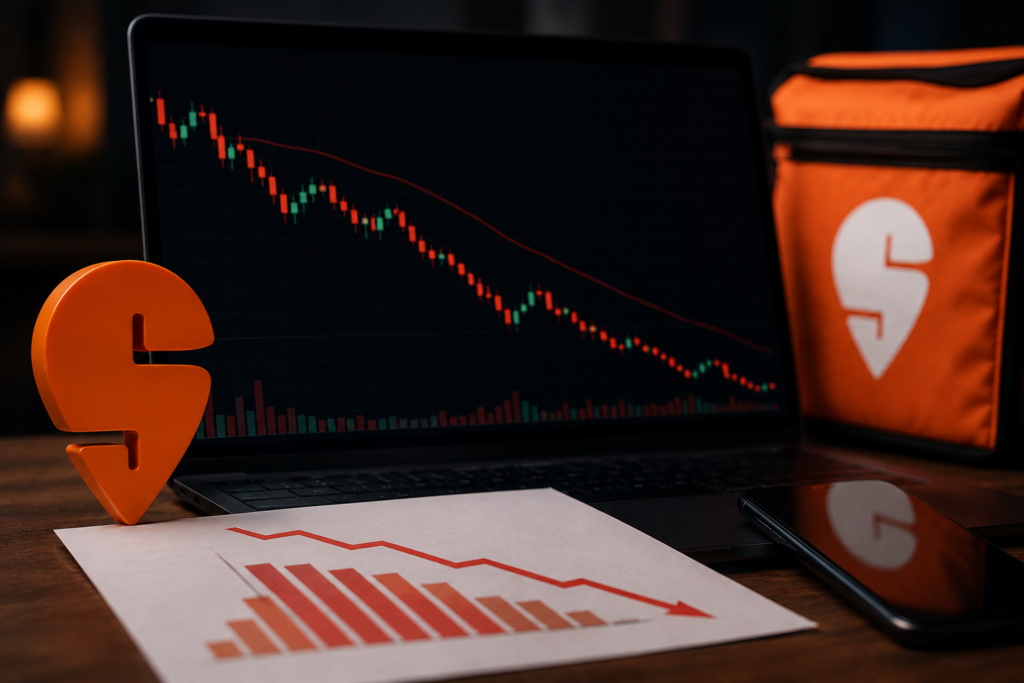
This is where the Swiggy story takes a painful turn.
After hitting its all-time high of Rs 617 in late December 2024, the stock entered a sustained decline that’s lasted well into 2026. The trajectory has been almost continuously downward, punctuated by brief rallies that faded quickly.
By May 13, 2025, Swiggy hit Rs 297 – a 52-week low that represented a 52% crash from the all-time high and a 24% decline from the IPO price. The trigger was a double blow: weak Q4 FY25 results (losses widened to Rs 1,081 crore) and the expiry of the six-month pre-IPO lock-in period, which unleashed selling pressure from early investors.
As of early June 2026, the Swiggy share price trades around Rs 241, near its updated 52-week low of Rs 238.50. The stock has declined approximately 38-39% from its IPO price of Rs 390 and over 61% from its all-time high. Market cap sits at roughly Rs 63,000 crore.
In January 2026, Swiggy raised Rs 10,000 crore through a QIP (Qualified Institutional Placement) at Rs 375 per share. While this strengthened the balance sheet, the subsequent price decline means QIP investors are also underwater.
For comparison, anyone who bought at the all-time high of Rs 617 and held to the current Rs 241 has lost over 61% of their investment in about 18 months.
Source: Business Standard (May 13, 2025); Tickertape; Kotak Neo; Bajaj Finserv; Whalesbook
Swiggy vs Zomato: Who Won the IPO Battle?
This is the comparison everyone wants to read. And the verdict is pretty clear – so far, Zomato has won this battle convincingly.
Zomato went public in July 2021 at Rs 76 per share with a market cap of approximately Rs 1.07 lakh crore. Despite early struggles, the stock has delivered multi-bagger returns. By late 2024, Zomato (now rebranded as Eternal) crossed Rs 2 lakh crore in market cap. The company achieved profitability in FY24, reporting Rs 351 crore PAT after years of losses.
Swiggy listed in November 2024 at Rs 420 with a market cap of around Rs 1 lakh crore. Since then, the market cap has shrunk to approximately Rs 63,000 crore. The company remains firmly loss-making.
On the operational front, Zomato leads in every major metric. In food delivery, Zomato commands about 58% market share versus Swiggy’s declining share. In quick commerce, Zomato’s Blinkit has higher gross order value and a positive contribution margin (4%), while Swiggy’s Instamart was still at a negative 3.18% contribution margin at the time of IPO. Blinkit also operates more dark stores.
The financial gap is even starker when you look at recent numbers. In FY24, Zomato reported revenue of Rs 12,114 crore with a Rs 351 crore profit. Swiggy reported Rs 11,247 crore revenue with a Rs 2,350 crore loss. By FY26, Swiggy’s revenue jumped 51% to Rs 23,053 crore (significantly higher than Zomato’s comparable period), but losses also ballooned to Rs 4,154 crore.
Revenue growth is strong, no question. But the profitability gap between these two companies continues to widen, not narrow. Zomato’s food delivery EBITDA margin improved to 2.8% by FY24. Swiggy’s was still at -0.2%.
This isn’t just an academic comparison. If you’re evaluating the Swiggy vs Zomato IPO question, the market has already spoken. Zomato’s stock has been a wealth creator. Swiggy’s has been a wealth destroyer – at least for those who bought at or near IPO.
If you’re interested in how other large IPOs performed compared to Swiggy, check out our analyses of the Hyundai Motor India IPO and the Tata Capital IPO.
Source: Kotak Securities; ICICI Direct; 5Paisa; Benzinga; Upstox
Financial Analysis: Revenue Growth, Path to Profitability
Let’s give Swiggy credit where it’s due. The top line is growing fast.
For FY26, Swiggy reported revenue from operations of Rs 23,053 crore – a massive 51.4% jump from Rs 15,227 crore in FY25. Q4 FY26 alone saw revenue of Rs 6,383 crore, up 44.7% year-on-year.
The problem? Losses grew even faster in absolute terms. FY26 net loss came in at Rs 4,154 crore, widening from Rs 3,117 crore in FY25. Q4 FY26 loss was Rs 800 crore, though this actually represents a 26% improvement from the Rs 1,081 crore loss in Q4 FY25. There’s a positive trajectory on a quarterly basis, but the annual number is still ugly.
EBITDA remains deeply negative at Rs -3,231 crore. The EBIT-to-interest coverage ratio stands at a concerning -30.90. The P/E ratio is literally meaningless here because there are no earnings – it shows as -15 to -20 on various platforms.
The company is burning cash on Instamart expansion, aggressive dark store rollouts, and customer acquisition costs. IIFL Capital, which initiated coverage with a Buy rating and Rs 535 target in June 2025, expected overall quick commerce to grow at 50% CAGR over FY25-28. The thesis is that scale will eventually bring profitability, as it did for Zomato’s food delivery segment.
Swiggy has also been cutting expenses meaningfully – technology costs, advertising, and employee expenses have all been reduced as a percentage of revenue compared to 2022 levels. But when your revenue is Rs 23,000 crore and your loss is Rs 4,154 crore, the path to breakeven still looks long.
For those tracking India’s largest IPO stories, Swiggy’s financial trajectory stands in contrast to profitable offerings like the Bajaj Housing Finance IPO or the HDB Financial Services IPO.
Source: Tickertape; Business Standard (May 2025); IIFL Capital Research (Jun 2025); Whalesbook
Investor Verdict: Was Swiggy IPO Worth It?
This is not investment advice. Here’s a balanced look at where things stand.
For IPO investors, the math is brutal right now. You paid Rs 390 per share (or Rs 420 if you bought on listing day). The stock is at Rs 241. That’s a 38% loss from IPO price and a 43% loss from listing price. In roughly 19 months. No amount of growth narrative softens that.
For current evaluators, the picture has two sides. The bull case rests on India’s quick commerce opportunity (expected to hit $40 billion by FY30), Swiggy’s revenue growth momentum (51% YoY), improving quarterly loss trajectory, and JM Financial’s view that the market currently values only Swiggy’s food delivery business while giving zero value to Instamart and other verticals. At Rs 241, you’re buying at roughly one-third of the all-time high.
The bear case is equally compelling. The company is nowhere near profitability. Competition is intensifying – not just from Zomato/Blinkit, but also from Zepto in quick commerce. The pre-IPO investor lock-in expiry in May 2025 triggered heavy selling, and there may be more supply overhang ahead. FSSAI inquiries into quick commerce quality control add regulatory risk. And at a market cap of Rs 63,000 crore for a company losing Rs 4,154 crore annually, the valuation premium on hopes alone is substantial.
IIFL Capital sees 46% upside with a Rs 535 target. JM Financial recommends long-term accumulation at current levels. But Morgan Stanley and other global brokerages have been more cautious. The stock’s 39% decline over the past six months speaks louder than any brokerage target.
Disclaimer: This article is for informational purposes only and does not constitute investment advice. Stock prices and financial data referenced are based on publicly available sources and may have changed since the time of writing. Always consult a SEBI-registered financial advisor before making investment decisions.
Last updated: June 2026
