
When HDFC Bank decides to list its lending arm, you pay attention. HDB Financial Services raised Rs 12,500 crore through its IPO in June 2025, making it the largest NBFC IPO in India’s history and the biggest public issue of calendar year 2025. The listing on July 2 delivered a solid 13% premium. But fast forward to June 2026, and the story has gotten more complicated.
This deep-dive covers the full HDB Financial Services IPO journey – from the subscription drama and GMP swings to the listing day pop, post-listing correction, and what the financials actually say about the business underneath. Whether you’re tracking the hdb financial services ipo gmp, checking the hdb financial ipo listing price, or simply monitoring the hdb financial share price today, this analysis gives you the complete picture.
HDB Financial Services: HDFC Bank’s NBFC Arm – Overview
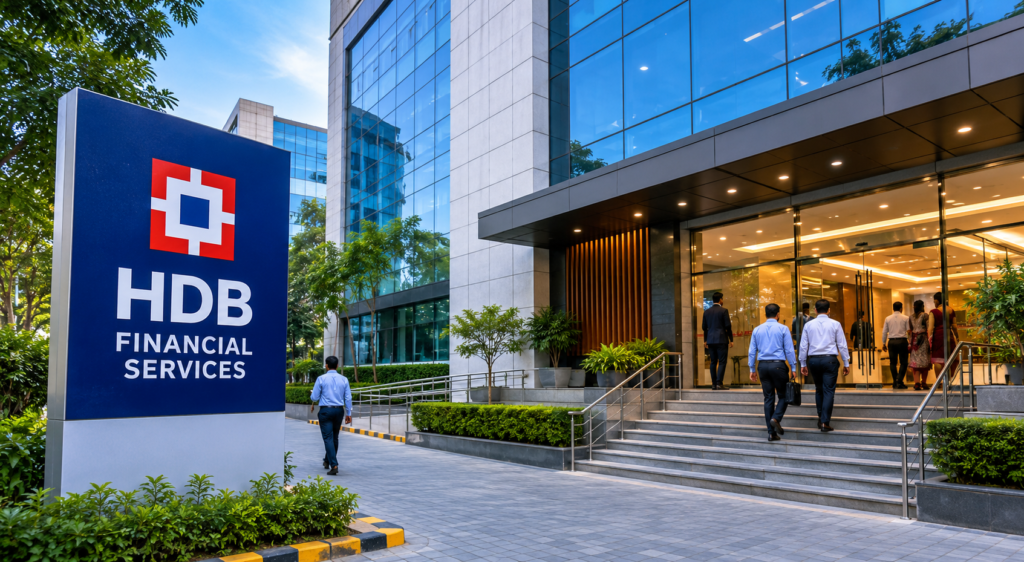
HDB Financial Services Limited was incorporated in 2007 and is headquartered in Ahmedabad, Gujarat. It’s a retail-focused non-banking financial company (NBFC) classified by the RBI as an Upper Layer NBFC. And that classification is exactly why this IPO happened – RBI regulations require Upper Layer NBFCs to list publicly by September 2025.
The company is a subsidiary of HDFC Bank, India’s largest private sector bank. Before the IPO, HDFC Bank held a 94.04% stake. Post-IPO, that came down to 74.1%, still firmly in control.
As of March 2026, HDB Financial operates 1,730 branches across 1,161 cities and towns in 31 states and union territories. The company serves 17.5 million customers through three core lending verticals – Enterprise Lending, Asset Finance, and Consumer Finance. It’s the seventh-largest diversified NBFC in India by gross loan book size, which stood at Rs 90,220 crore as of March 2024 and grew to Rs 1,18,493 crore by March 2026.
What’s distinctive about HDB is its focus on underserved and underbanked customers. The average exposure per customer is just Rs 1.66 lakh – that tells you the book is extremely granular and retail-heavy.
Source: HDB Financial Services RHP; Chittorgarh.com; HDB Q4 FY26 Earnings Call
IPO Details: Rs 12,500 Cr – Largest NBFC IPO in India Ever
The numbers here are worth absorbing. At Rs 12,500 crore, this was not just the largest NBFC IPO ever in India – it was the fourth-largest public offering in Indian market history at the time, behind Hyundai (Rs 27,870 Cr), LIC, and Paytm.
The IPO comprised a fresh issue of 3.38 crore equity shares aggregating Rs 2,500 crore and an offer for sale (OFS) of 13.51 crore equity shares worth Rs 10,000 crore by the promoter HDFC Bank. The fresh issue proceeds were earmarked for augmenting HDB’s Tier-I capital base to support future lending growth.
The IPO opened on June 25, 2025, and closed on June 27, 2025. Allotment was finalized on June 30, with listing on both BSE and NSE on July 2, 2025. Anchor investors committed Rs 3,369 crore on June 24 – participants included LIC, ICICI Prudential Mutual Fund, Nippon Life, and Goldman Sachs Funds.
A total of 12 book-running lead managers handled the issue, including JM Financial, BNP Paribas, BofA Securities, Goldman Sachs, HSBC Securities, Jefferies, Morgan Stanley, Motilal Oswal, and Nomura. MUFG Intime India (formerly Link Intime) served as the registrar.
One notable feature: 10% of the issue size (Rs 1,250 crore) was reserved for existing HDFC Bank shareholders, with a record date of June 19, 2025. This was a smart move to drive demand from an already loyal investor base.
Source: BusinessToday (Jun 20, 2025); Business Standard; Chittorgarh.com; Kotak Neo
Price Band, Lot Size and Subscription Analysis
The price band was set at Rs 700 to Rs 740 per share, with a face value of Rs 10. The floor and cap prices represented 70x and 74x the face value respectively. The minimum lot size was 20 shares, requiring a retail investment of Rs 14,800 at the upper band.
Category-wise allocation was 50% for QIBs, 35% for retail investors, and 15% for NIIs. There was an additional employee reservation of Rs 20 crore.
The final subscription numbers paint an interesting picture. The overall IPO was subscribed 16.69 times – a strong result for an issue this size. But the category breakdown reveals where the real demand came from. QIBs went all in at 55.47 times. NIIs subscribed 9.99 times. Retail investors managed just 1.41-1.51 times. Employees subscribed 2.46 times, and the HDFC Bank shareholder quota finished at 1.21 times.
The QIB number is especially telling. When institutions oversubscribe 55 times, they’re making a clear statement about the business quality and valuation. But it took them until the final day to fully commit, which created anxiety throughout the subscription period.
Source: mStock; Chittorgarh.com; Business Standard (Jun 26, 2025)
Day-1 Slow Start: Why Did Retail Investors Hesitate?
This was the headline that rattled market watchers. On Day 1 (June 25, 2025), HDB Financial’s IPO was subscribed just 0.13 times. That’s 13% of the total shares on offer. Retail was at 0.14 times. NII at 0.18 times. And QIBs? Virtually zero – just 25,360 shares applied for.
For India’s largest NBFC IPO, backed by HDFC Bank, this was an embarrassing start. By Day 2, total subscription had only reached 69%. Business Standard reported the headline as “subscription lags” with employees leading the pack at 2.46 times.
So what went wrong on Day 1?
The Rs 12,500 crore issue size was massive, requiring an enormous pool of capital to fill. Large issues typically see back-loaded demand, with QIBs waiting until the final day to assess pricing and market conditions. The NBFC sector was also facing headwinds – rising NPAs across the industry, tighter RBI scrutiny, and concerns about retail loan stress had dampened overall sector enthusiasm.
There was also a valuation debate. While the Rs 700-740 price band appeared reasonable compared to unlisted market prices (which had traded at implied P/B multiples of 5-7x according to UnlistedZone), some analysts noted that FY25 had actually seen HDB’s profit decline by 12% due to rising provisioning costs. That’s not the trajectory you want when pricing an IPO.
The turnaround came on Day 3, when QIBs flooded in. The institutional conviction ultimately carried the issue to a strong 16.69x overall subscription.
Source: 5Paisa (Jun 25, 2025); Business Standard (Jun 26, 2025); UnlistedZone; ClearTax
GMP Journey: 9% Premium Pre-Listing
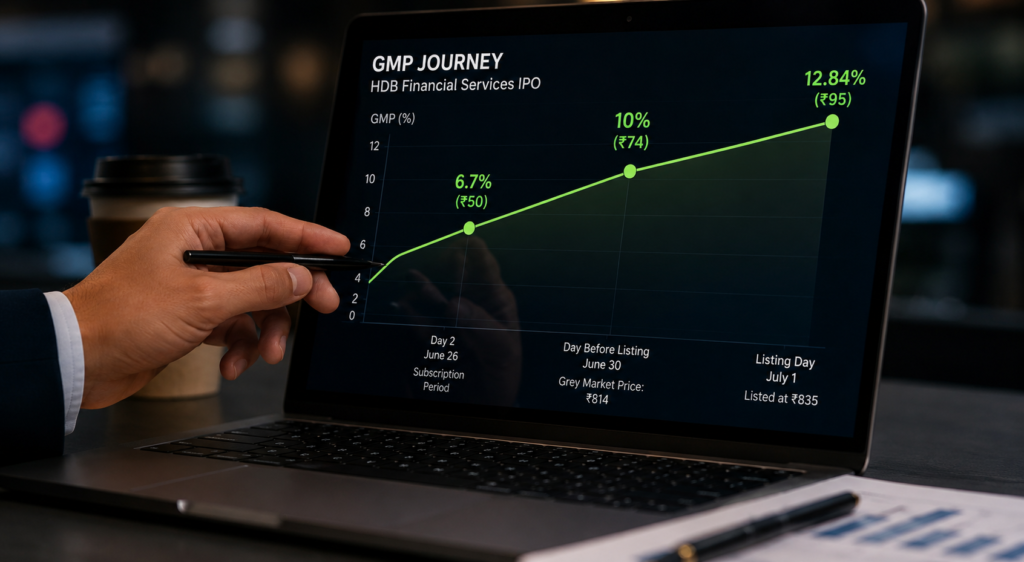
The grey market premium trajectory for HDB Financial was notably smoother than some other large IPOs of 2024-25, but it still had its swings.
During the subscription period on Day 2 (June 26), grey market sources indicated HDB Financial shares commanding a premium of around Rs 50, translating to a GMP of 6.7% over the upper band of Rs 740. This was modest but positive, especially given the sluggish subscription numbers at that point.
As the final subscription data emerged showing 16.69x oversubscription (driven by QIB demand), the GMP climbed. By the day before listing, unlisted shares were trading at approximately Rs 814 in the grey market – a premium of Rs 74, or about 10% over the issue price.
Some trackers had pegged the estimated listing price even higher at Rs 815, with expectations of a 10-14% listing gain. The actual listing at Rs 835 (12.84% premium) ended up beating most GMP estimates – a pleasant surprise for a change.
Source: Business Standard (Jun 26, Jul 2, 2025); India TV News (Jul 2, 2025)
Listing Date: July 2, 2025 – Listing Day Performance
July 2, 2025. HDB Financial Services made its stock market debut. And it was a good one.
Shares listed at Rs 835 on both NSE and BSE, reflecting a 12.84% premium over the IPO issue price of Rs 740. The stock touched an intraday high of Rs 845.75 and a low of Rs 829. By end of day, shares closed at Rs 840.95 – a gain of nearly 14% from the issue price.
Bloomberg reported that this was the second-best listing-day performance by any Indian IPO since 2010 that raised at least $1.5 billion. That’s a remarkable stat for an NBFC that struggled to fill 13% of its book on Day 1.
Per lot, investors who applied at the upper band of Rs 740 and got allotment were sitting on a profit of Rs 1,900 per lot (20 shares x Rs 95 premium) on listing day. Not spectacular, but a solid debut for an issue of this scale.
The post-listing trading on Day 2 and 3 held up well. By July 15, when the company held its first-ever board meeting as a listed entity to discuss Q1 FY26 results, shares were trading around Rs 843. The initial stability suggested that the institutional demand wasn’t just about flipping.
Source: Business Standard (Jul 2, 2025); Bloomberg (Jul 2, 2025); India TV News; Upstox
Financial Analysis: Loan Book, NPA Ratios, Revenue Growth
Here’s where the long-term investment case gets built or broken.
For FY25, HDB Financial’s AUM stood at Rs 1,07,262 crore – crossing the Rs 1 lakh crore milestone. Total income from lending was Rs 15,084 crore, growing at a 10-year CAGR of 19.9%. Net total income from lending reached Rs 8,693 crore. However, FY25 profit came under pressure, with profitability impacted by rising provisioning costs and NPA stress in the retail segment.
FY26 showed a meaningful recovery. Total income grew 13% to Rs 18,430 crore. PAT climbed 16.9% to Rs 2,544 crore from Rs 2,176 crore in FY25. The gross loan book expanded 10.9% year-on-year to Rs 1,18,493 crore. Asset Finance and Enterprise Lending each contributed 38% of the loan mix, with Consumer Finance making up the rest.
Q4 FY26 was particularly strong. PAT jumped 41% year-on-year to Rs 751 crore. NII grew 21.6%. Net interest margin expanded from 7.6% in Q4 FY25 to 8.20% in Q4 FY26 – a 60-basis-point improvement driven by declining borrowing costs as RBI cut rates. Pre-provisioning operating profit for the full year grew 27%.
On asset quality, Gross NPA was 2.44% as of March 2026, improving from 2.81% in December 2025. This marks a positive trend after NPA levels had been creeping upward through FY25. Credit costs remain manageable at approximately 23 basis points according to Morgan Stanley’s analysis.
The company carries CRISIL AAA/Stable and CARE AAA/Stable ratings, and its CRAR stood at 19.2% as of FY25.
Digital transformation is also progressing fast. HDB achieved 98.31% digital sourcing in FY26 – nearly every loan originated through digital channels.
Source: Screener.in; HDB Q3/Q4 FY26 Investor Presentations; Univest (Apr 16, 2026); Whalesbook; Yahoo Finance Q4 FY26 Earnings Call
HDFC Bank Connection: Strategic Advantage or Conflict?
This is the question that comes up in every analyst meeting. Having HDFC Bank as your parent is both a blessing and a potential complication.
The advantages are substantial. HDB Financial benefits from HDFC Bank’s brand trust, distribution network, and customer base. The bank provides business process outsourcing referrals, and HDB distributes insurance products to its lending customers. The HDFC Bank parentage also ensures access to lower-cost funding compared to standalone NBFCs, which directly supports NIM.
CRISIL’s AAA rating for HDB explicitly factors in the strong HDFC Bank parentage. That rating translates to cheaper borrowing across NCDs and other debt instruments – a real competitive edge.
The potential conflict? HDFC Bank itself is a massive retail lender. The question of where a customer gets served – by the bank directly or through HDB Financial – creates overlap. HDB targets the underbanked and semi-urban/rural segment, which theoretically reduces cannibalization. But as HDFC Bank pushes deeper into semi-urban markets post its merger with HDFC Ltd, the line could blur.
There’s also the governance angle. HDFC Bank’s stake dropped from 94% to 74% after the OFS. That’s still dominant control, but it means minority shareholders now have skin in the game. The Rs 10,000 crore OFS effectively monetized HDFC Bank’s investment in HDB, and some investors viewed this as the parent cashing out at an opportune moment.
Source: HDB Financial RHP; CRISIL Rating Reports; ICICI Direct IPO Analysis
Post-Listing Share Price Movement (Jul 2025 – Now)
The post-listing journey has been, frankly, painful for investors who held from listing day.
After debuting at Rs 835 and closing at Rs 841 on July 2, the stock initially held up well. Around mid-July, when Q1 FY26 results showed a 2.4% drop in net profit to Rs 568 crore, shares fell about 4% in a single session to Rs 810. The tepid first quarter as a listed company set a cautious tone.
The stock hit its 52-week high of Rs 891.90 sometime in early trading months, but then entered a sustained downtrend. By the time Q4 FY26 results were announced in April 2026 (showing the 41% PAT jump), shares had already corrected to around Rs 645 – and rallied 12.4% to Rs 724 on the results day.
However, the broader correction resumed. The stock touched a 52-week low of Rs 555.30 during a period of market-wide weakness. As of early June 2026, the HDB Financial share price trades around Rs 615, roughly 17% below its IPO issue price of Rs 740.
The PE ratio has compressed to about 20-22x, and the P/B ratio sits at around 2.5-2.7. Market capitalization hovers around Rs 52,000 crore. Morgan Stanley maintains an Equal-Weight rating with a target price of Rs 720, citing stable collections and expected NIM sustenance above 8%.
For IPO investors, the listing-day gain of 13% has turned into a 17% loss if held to date. That’s the kind of swing that tests conviction.
Check HDB Financial Live Price
Source: ICICI Direct; Bajaj Finserv; Screener.in; Business Standard (Jul 16, 2025); Groww
Investor Verdict: Is HDB Financial a Long-Term Buy?
This is not investment advice. Here’s an objective look at both sides of the argument.
The bull case starts with the HDFC Bank parentage and the structural India credit growth story. NBFCs have grown from less than Rs 2 trillion AUM at the turn of the century to Rs 41 trillion by FY24, and CRISIL expects NBFC credit to grow at 15-17% CAGR through FY27. HDB Financial’s FY26 results showed a genuine inflection – 16.9% PAT growth, NIM expansion, improving asset quality, and strong digital adoption (98.31% digital sourcing).
The company’s management has guided for medium-term loan growth at nominal GDP plus 6-7% CAGR. At the current price near Rs 615, you’re buying at a P/B of about 2.5 – significantly cheaper than where the stock listed at Rs 835. If NPA trends continue improving and the AUM growth target holds, the valuation re-rating potential is meaningful.
The bear case points to real concerns. The stock has fallen 17% below its IPO price in under a year. GNPA at 2.44% is still elevated compared to pre-COVID levels. FY25 saw a profit decline, and the turnaround in FY26 came partly from lower funding costs (an external tailwind, not operational improvement). Competition from Bajaj Finance, Cholamandalam, and other listed NBFCs is intensifying. And HDFC Bank’s large OFS – Rs 10,000 crore worth – signaled that the parent saw value in monetizing at the IPO price rather than holding for future upside.
Morgan Stanley’s Rs 720 target suggests about 17% upside from current levels. That’s not a screaming buy, but for a AAA-rated NBFC with a Rs 1.18 lakh crore loan book and HDFC Bank backing, the risk-reward at current prices may be more favorable than at listing.
Source: Morgan Stanley Research; CRISIL NBFC Report; Groww; Screener.in
Disclaimer: This article is for informational purposes only and does not constitute investment advice. Stock prices and financial data referenced are based on publicly available sources and may have changed since the time of writing. Always consult a SEBI-registered financial advisor before making investment decisions.
Last updated: June 2026
