
This is the IPO story nobody predicted. Ola Electric listed in August 2024, hit 20% upper circuits for two straight days, doubled from its issue price within a week, and made investors feel like geniuses. Then it gave back nearly everything. And then some more.
As of June 2026, the Ola Electric share price hovers around Rs 40-45 – roughly 42-47% below its IPO issue price of Rs 76 and over 70% below its all-time high of Rs 157.53. The company that was supposed to be India’s answer to Tesla has lost its market leadership, seen deliveries collapse 61% in a single quarter, and watched SoftBank quietly reduce its stake.
This analysis covers the full Ola Electric IPO story – the euphoric listing, the GMP history, the spectacular rise, the devastating fall, and what the numbers say about whether a recovery is possible. If you’re tracking the ola electric ipo gmp, looking for the ola electric ipo listing price, or checking the ola electric share price today, this is your honest, data-backed guide.
Ola Electric: India’s First EV Company IPO – Story
Ola Electric Mobility Limited was incorporated in February 2017 by Bhavish Aggarwal, the same entrepreneur behind ride-hailing platform Ola Cabs. The company made its IPO debut on August 9, 2024, becoming the first pure-play electric vehicle company to list on Indian stock exchanges.
The business model is ambitious – Ola Electric builds vertically integrated technology and manufacturing capabilities for EVs and EV components, including battery cells. The company manufactures electric scooters and core components like battery packs, motors, and vehicle frames at its Ola Futurefactory in Tamil Nadu, one of Asia’s largest EV manufacturing facilities with an installed capacity of one million units annually.
At the time of IPO, Ola Electric commanded roughly 35-39% of India’s electric two-wheeler market in FY24. The company had delivered seven products since launching its first model, the S1 Pro, in December 2021. It operated 870 experience centres and 431 service centres across India as of March 2024.
The investor lineup was impressive – SoftBank, Temasek, Tiger Global, and Matrix Partners were among the key backers. The vision was clear: become the dominant player in India’s EV revolution, manufacture everything in-house, and scale to profitability.
Source: Ola Electric RHP; Chittorgarh.com; CNBC (Aug 9, 2024)
IPO Details: Rs 6,145 Cr, Price Band Rs 72-76 Per Share
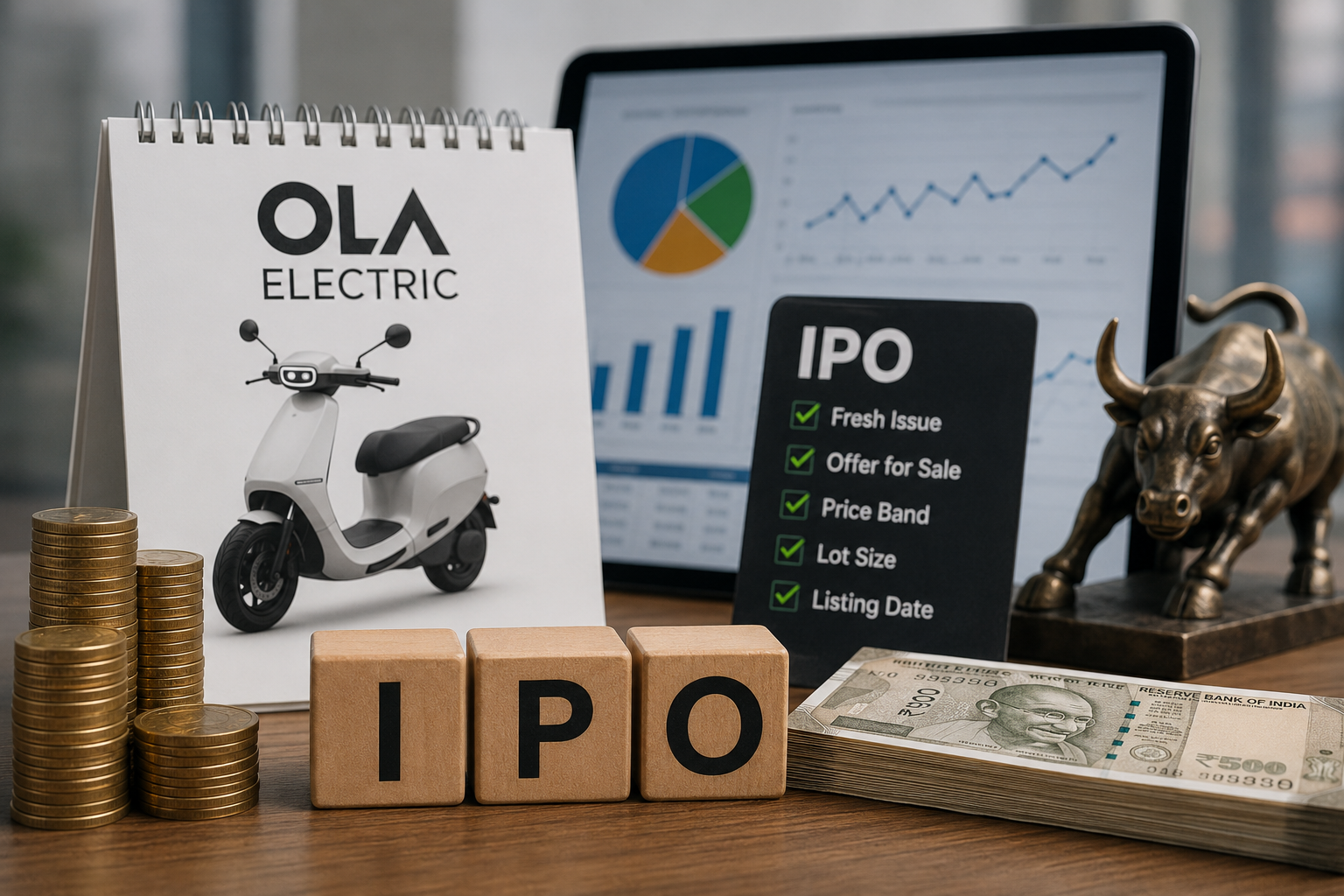
The Ola Electric IPO was a book-built issue worth Rs 6,145.56 crore. It comprised a fresh issue of 72.38 crore equity shares (raising Rs 5,500 crore) and an offer for sale of 8.49 crore shares (worth Rs 645.56 crore) with a face value of Rs 10 each.
The price band was set at Rs 72 to Rs 76 per share. Lot size was 195 shares, requiring Rs 14,820 at the upper band for retail investors. The IPO opened on August 2, 2024, and closed on August 6, 2024. Allotment was finalized on August 7, with listing on BSE and NSE on August 9, 2024.
Fresh issue proceeds were earmarked for Rs 1,228 crore in capital expenditure (cell manufacturing), Rs 800 crore for debt repayment, Rs 1,600 crore for R&D, Rs 350 crore for organic growth, and the rest for general corporate purposes.
Anchor investors committed Rs 2,763 crore on August 1, with 84 anchor investors participating. The overall subscription reached 4.27 times. QIBs subscribed 5.31 times, retail investors 3.92 times, and NIIs 2.40 times. The employee reservation included 7.97 lakh shares at a Rs 7 discount.
At the time, this was India’s biggest IPO of 2024 (before the Hyundai Motor India IPO arrived in October). Kotak Mahindra Capital, BofA Securities, Axis Capital, and SBI Capital Markets served as book-running lead managers.
Source: Chittorgarh.com; Business Standard (Aug 9, 2024); mStock; Kotak Neo
GMP History: Pre-Listing Grey Market Premium
The grey market premium for Ola Electric was positive but modest heading into the listing. Most grey market trackers indicated a GMP of Rs 5-10 above the upper band of Rs 76 in the days before listing – suggesting a potential listing price of Rs 81-86, or about a 7-13% gain.
The 4.27x subscription provided confidence, but the number wasn’t overwhelming enough to drive aggressive GMP pricing. The biggest uncertainty was the fact that Ola Electric was a loss-making company in a sector where profitability timelines were unclear. Grey market participants were cautious.
Some early GMP estimates had been higher when the IPO was first announced, driven by the EV narrative and Bhavish Aggarwal’s celebrity-CEO status. But as analysts published their reviews highlighting the company’s Rs 1,584 crore loss in FY24 and the heavy competition from Bajaj, TVS, and Ather, the premium moderated.
The actual listing performance, as we’ll see next, initially validated the cautious-to-positive GMP range before blowing past all expectations in the following days.
Source: Chittorgarh.com; Business Standard; IPO Watch
Listing Day: August 9, 2024 – Listed Flat, Surged 10%
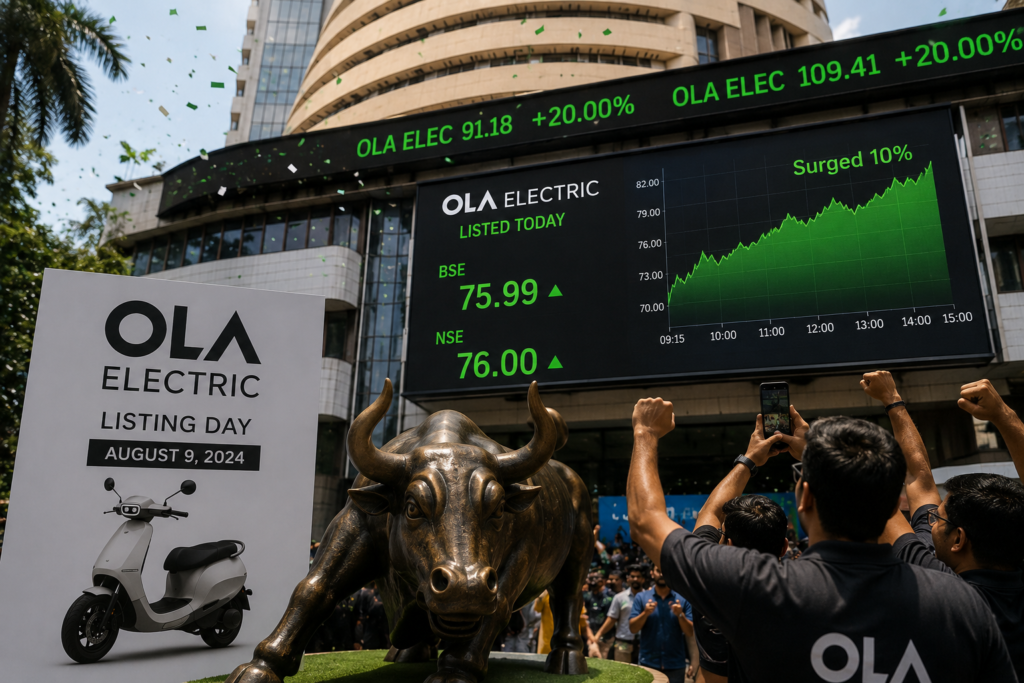
August 9, 2024. Ola Electric hit the exchanges. And the opening was… underwhelming.
Shares listed at Rs 75.99 on BSE – a marginal discount to the issue price of Rs 76. For a brief moment, it looked like the bears were right. But within minutes, buying momentum kicked in. The stock surged to Rs 82.30 (8.3% premium), then kept climbing. By mid-morning, CNBC reported a 10% surge, valuing the company at approximately $4.4 billion (Rs 36,945 crore).
Then things went vertical. The stock hit the 20% upper circuit at Rs 91.18 on listing day itself. On the following Monday (August 12), it hit the 20% upper circuit again at Rs 109.41. By August 16, five trading days after listing, Ola Electric was trading at Rs 133.08 – a staggering 75% above its issue price.
HSBC initiated coverage with a Buy rating and Rs 140 target. The buzz around Ola’s new Roadster motorcycle announcement on August 15 added fuel to the rally. By August 20, the stock touched its all-time high of Rs 157.53 – more than doubling from the IPO price in less than two weeks.
For anyone who applied at Rs 76 and held through that first week, it felt like the trade of the year.
Source: Business Standard (Aug 9, Aug 12, Aug 16, 2024); CNBC (Aug 9, 2024); Reuters
Current Share Price: Rs 40-45 (June 2026) – Down 42-47% from IPO
Now for the part nobody wants to read but everyone needs to.
As of mid-June 2026, the Ola Electric share price trades around Rs 40-45. The stock touched an all-time low of approximately Rs 27 in early 2026. The 1-year return stands at approximately -75% according to Motilal Oswal data. Market capitalization has shrunk from a peak of nearly Rs 59,000 crore to roughly Rs 18,000-19,000 crore.
The decline from the all-time high of Rs 157.53 to current levels represents an 72-85% crash. From the IPO price of Rs 76, investors are sitting on a 42-47% loss. For anyone who bought near the peak, the damage is even more severe.
The stock has shown occasional bounces – a 50% rally from its all-time low of Rs 21 to Rs 34 in seven sessions at one point – but each recovery has been short-lived. The overall trend since September 2024 has been relentlessly downward.
Vanguard, one of the world’s largest asset managers, reportedly slashed its valuation of Ola Electric from $5 billion to just $70.3 million – a 98.6% markdown.
Source: Bajaj Finserv; Motilal Oswal; Groww; Sahi.com; Investwhat.in
What Went Wrong? Delivery Issues, Competition and Mounting Losses
This section matters most. Here’s an honest breakdown of why Ola Electric collapsed.
Delivery volumes cratered. This is the core issue. Vehicle deliveries fell from 1,25,000 units in Q1 FY26 to just 32,680 units in Q3 FY26 – a 61% sequential collapse in two quarters. Q4 FY25 deliveries were 51,375 units, already down 55% from 1,15,386 units in Q4 FY24. This isn’t seasonal softness. This is structural demand destruction.
Market share evaporated. Ola Electric’s market share in the E2W segment plummeted from approximately 49% in Q1 FY25 to roughly 16% by Q2 FY26, and further to just 5.87% by January 2026. The company fell from first place to fourth in the electric two-wheeler market. Competitors like Bajaj Auto (Chetak), TVS (iQube), and Ather Energy aggressively captured the share Ola was losing.
Quality and service failures damaged the brand. Customer experience deteriorated around Gen1 scooters. Warranty costs ballooned from Rs 12.9 crore in FY22 to Rs 560 crore in FY25. The company booked a one-time Rs 250 crore provision in FY25 for lifetime warranty obligations. Social media amplified service complaints, and brand perception suffered in a way that’s hard to reverse quickly.
SoftBank started selling. SoftBank reduced its stake from over 17% at IPO to 13.53% by January 2026, selling more than 9.4 crore shares between September 2025 and January 2026. When your biggest institutional backer is heading for the exit, it sends a clear signal.
Execution promises kept getting pushed back. The gigafactory target was repeatedly scaled down – from 20 GWh to 6 GWh by March 2026. Break-even targets moved from 50,000 units to 25,000 to 15,000 units. Each revision eroded credibility.
Similar to how the Swiggy IPO faced post-listing struggles due to persistent losses, Ola Electric’s story shows that growth narrative alone doesn’t sustain stock prices when execution falters.
Source: Outlook Business (Feb 18, 2026); Univest; Samco; MarketsMojo; The Loggical Investor
Financial Analysis: Revenue Up 90% (FY24), But Losses Widened
The financial trajectory tells the story of a company that grew spectacularly and then hit a wall.
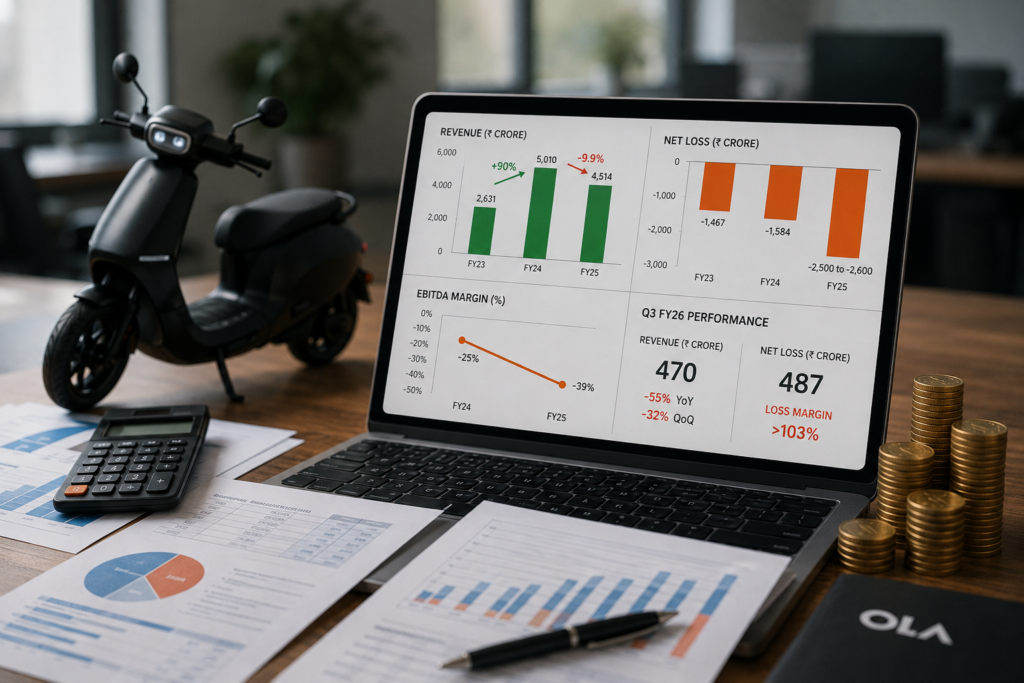
FY24 was the peak growth year. Revenue surged 90% from Rs 2,631 crore in FY23 to Rs 5,010 crore in FY24. But losses also widened by 8% to Rs 1,584 crore. The company was clearly prioritizing scale over profitability.
FY25 brought the reversal. Revenue declined 9.9% to Rs 4,514 crore from Rs 5,010 crore in FY24. Net losses widened to approximately Rs 2,500-2,600 crore (exact full-year numbers vary by source). The combination of falling volumes, rising warranty costs, and intensifying competition destroyed the growth narrative.
FY26 has been even worse on a quarterly basis. Q3 FY26 revenue was just Rs 470 crore – down 55% year-on-year and 32% sequentially. Net loss was Rs 487 crore, with a loss margin exceeding 103% (the company lost more than its entire revenue). Nine-month FY26 revenue was Rs 1,988 crore with accumulated losses of Rs 1,333 crore.
The company’s auditor flagged going concern risks due to negative cash flows from operations (Rs 866 crore negative in nine months to December 2025) and continued operating losses. EBITDA margins deteriorated from -25% in FY24 to -39% in FY25.
One positive development: May 2026 sales reached 15,139 units, a 7-month high with 23% month-on-month growth. The Gen 3 scooter platform and Roadster X motorcycle launch show the company is still innovating. But from the scale Ola was at (1.25 lakh units per quarter), the current volumes are a fraction of what’s needed.
Source: Groww; Univest; MarketsMojo; Sahi.com; Business Standard
EV Market Outlook: Can Ola Electric Recover?
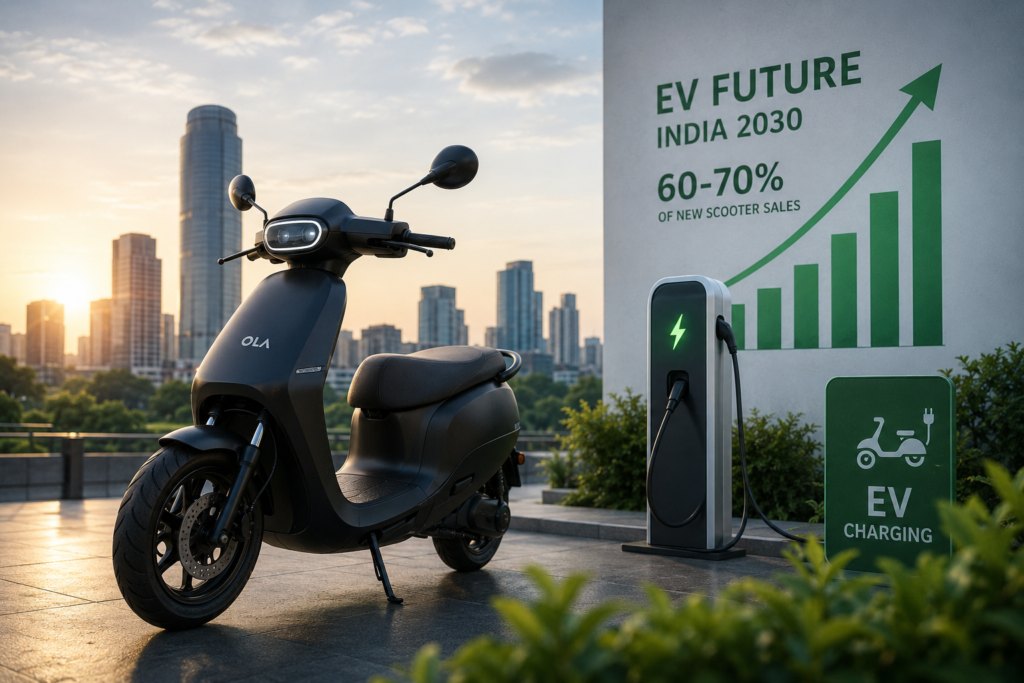
The EV opportunity in India hasn’t disappeared. By 2030, electric two-wheelers are expected to account for 60-70% of all new scooter sales in India according to McKinsey. The market is expanding rapidly, with multiple players scaling up.
Ola’s potential recovery hinges on three things. First, the Gen 3 platform and Roadster X motorcycle must gain traction and deliver a better customer experience than the Gen 1 scooters that damaged the brand. Second, the Gigafactory’s indigenous battery cell production (the Bharat Cell, which commenced production in 2025) needs to bring costs down meaningfully. Third, service quality and network reliability must improve to rebuild trust.
The competitive landscape is tough. TVS iQube, Bajaj Chetak, and Ather Energy have all gained significant market share while Ola was struggling. And they don’t carry the brand baggage that Ola currently does.
At current prices near Rs 40-45, the stock is pricing in near-terminal pessimism. If volumes stabilize and the motorcycle segment gains traction, there’s meaningful upside from deeply compressed valuations. But the keyword is “if.” The company needs to demonstrate several consecutive quarters of volume recovery and loss narrowing before the market will re-rate the stock.
For a contrasting IPO story where the EV narrative met strong execution, consider reading about the Bajaj Housing Finance IPO – same market, very different outcome.
Source: McKinsey India EV Report; CNBC (Aug 9, 2024); Emkay Global Research
Investor Verdict: Lessons Learned from Ola Electric IPO
This is not investment advice. But there are real lessons here.
For IPO investors who held from Rs 76, the loss is around 42-47%. For those who bought near the all-time high of Rs 157, the loss exceeds 70%. This is one of the worst-performing major IPOs in recent Indian market history.
The lessons are worth internalizing. First, momentum is not fundamentals. A stock hitting 20% upper circuits for consecutive days doesn’t mean the business is worth double its IPO valuation. Ola doubled in a week on pure sentiment, then spent 18 months giving it all back plus more. Second, loss-making companies in competitive markets carry binary risk. When the growth story breaks – as it did when deliveries collapsed – there’s no earnings floor to support the stock. Third, watch what insiders do, not what they say. SoftBank’s systematic stake reduction through late 2025 and early 2026 was the clearest possible signal.
At current prices, some analysts see deep value if Ola can execute its turnaround. May 2026 sales showing a 7-month high and the Roadster series launch provide glimmers of hope. But the road from Rs 40-45 back to Rs 76 (let alone Rs 157) requires a level of execution that Ola has not yet demonstrated as a public company.
For the broader IPO market perspective, check our IPO News page and analysis of other major listings including Tata Capital IPO and Reliance Jio IPO.
Disclaimer: This article is for informational purposes only and does not constitute investment advice. Stock prices and financial data referenced are based on publicly available sources and may have changed since the time of writing. Always consult a SEBI-registered financial advisor before making investment decisions.
Last updated: June 2026
