

A zero-commission e-commerce platform. Built for Bharat, not just India. An IPO subscribed 79 times over. A listing that blew past every grey market prediction. And six months later, a share price that’s had a wild ride from Rs 111 to Rs 254 to Rs 125 and back to Rs 165.
The Meesho IPO was one of the most talked-about listings of 2025, and for good reason. It attracted Rs 2,43,830 crore in bids through over 62 lakh applications, listed at a 46% premium, and made listing-day profits of Rs 6,952 per lot for retail investors. But the story didn’t end on December 10, 2025.
This deep-dive covers everything – the IPO mechanics, the meesho ipo gmp journey, the meesho ipo listing price performance, the meesho ipo allotment frenzy, post-listing meesho share price movement, financials, and whether the 79x subscription was justified. If you searched for meesho ipo 2025 details, this is your complete guide.
Meesho: Social Commerce Leader – Company Background

Meesho was founded in 2015 by Vidit Aatrey and Sanjeev Barnwal, both IIT Delhi alumni. Originally incorporated as FashNear Technologies Private Limited in Bengaluru, the company started as a social commerce platform enabling individuals to sell products through WhatsApp, Facebook, and Instagram with zero upfront capital.
Over time, Meesho evolved from a reseller-only model into a full-fledged e-commerce marketplace. And here’s what makes it different from Amazon, Flipkart, or Myntra – Meesho charges sellers zero commission. No platform fees for consumers either. The revenue comes from order fulfilment services, advertising, and data insights sold to sellers.
As of the 12-month period ending June 2025, Meesho was India’s largest e-commerce platform by placed orders and annual transacting users, according to the Redseer Report cited in its DRHP. The platform had accumulated 1.15 billion ratings, 346 million reviews, and 76 million consumer-generated images and videos. Its AI/ML-powered experimentation platform, Abacus, ran an average of 432 concurrent experiments per month.
The company’s focus on Tier-2, Tier-3, and Tier-4 cities gave it access to a massive, underserved consumer base that premium e-commerce players struggle to reach. Think affordable fashion, home essentials, and kitchen products at price points that work for a household earning Rs 25,000 a month. That’s the Meesho customer.
Key investors pre-IPO included SoftBank, Prosus (Naspers), Meta, Sequoia Capital, and Elevation Capital.
Source: Meesho RHP; Chittorgarh.com; Angel One; Redseer Report
IPO Details: Price Band, Issue Size, Subscription Dates (Dec 2025)
The Meesho IPO was a book-built issue worth Rs 5,421.20 crore. It comprised a fresh issue of 38.29 crore equity shares (raising Rs 4,250 crore) and an offer for sale of 10.55 crore shares (worth Rs 1,171.20 crore), with a face value of Re 1 each.
The price band was set at Rs 105 to Rs 111 per share. At the upper band, the company was valued at approximately Rs 52,500-53,000 crore (roughly $6 billion). The lot size was 135 shares, requiring Rs 14,985 for retail investors.
The IPO opened on December 3, 2025, and closed on December 5, 2025. Allotment was finalized on December 8. Shares were credited on December 9. And listing happened on December 10, 2025, on both BSE and NSE.
Fresh issue proceeds were earmarked for Rs 1,390 crore toward cloud infrastructure at subsidiary MTPL, Rs 480 crore for AI/ML and technology team salaries, Rs 1,020 crore for marketing and brand building, and the balance for inorganic growth and general corporate purposes.
Anchor investors committed Rs 2,439.54 crore on December 2. The category allocation was 75% for QIBs, 15% for NIIs, and 10% for retail. This QIB-heavy allocation (75% vs the typical 50% for many IPOs) reflected the company’s positioning as an institutional-grade tech listing.
Kotak Mahindra Capital, JP Morgan India, Morgan Stanley India, Axis Capital, and Citigroup Global Markets were the book-running lead managers. KFin Technologies served as registrar.
Source: Chittorgarh.com; Angel One; mStock; Business Standard
Massive Oversubscription: 79x – QIB 120x, Retail 19x
The subscription numbers for the Meesho IPO were staggering. This was one of the highest subscription multiples among large-scale new-age tech listings in recent Indian market history.
The overall subscription reached 79-82 times (different sources report final figures between 79.02x and 81.76x as bids continued processing). QIBs went absolutely berserk at 120.18 times – meaning institutional investors bid for 120 times more shares than available to them. NIIs subscribed 38.15 times. And retail investors came in at 19.04 times.
To put those numbers in perspective: over 62.75 lakh applications were received, generating total bids worth approximately Rs 2,43,830 crore – for an IPO raising Rs 5,421 crore. That’s roughly 45 times the money needed, chasing the available shares.
What drove this frenzy? Several factors. Meesho’s unique zero-commission model had no direct listed comparable. The Rs 111 price point was accessible to a broad retail base. Motilal Oswal highlighted that at 4.5x Price/Sales on FY25 revenue, the valuation looked reasonable compared to the industry average of approximately 7x. And the “value e-commerce for Bharat” narrative resonated strongly with institutions betting on India’s next 500 million internet consumers.
For those who checked their meesho ipo allotment status on December 8, the math was brutal. With 19x retail subscription, only about 1 in every 19 retail applicants received shares. Most walked away empty-handed.
Source: Chittorgarh.com; mStock; BusinessToday (Dec 10, 2025); PL Capital
GMP Journey: Pre-Listing Grey Market Premium Analysis
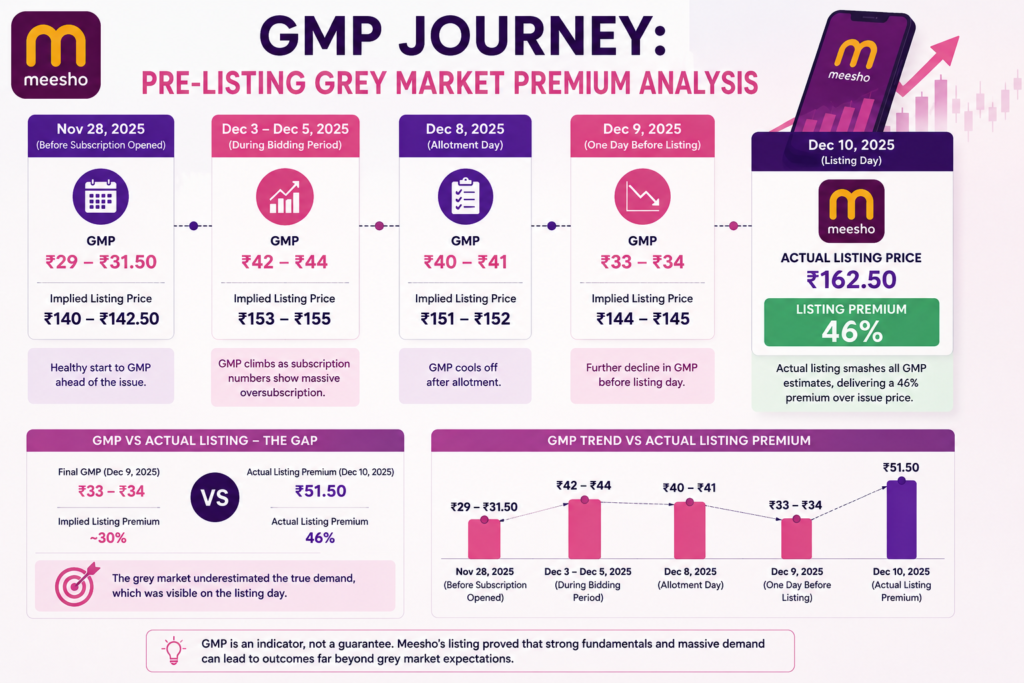
The grey market premium story for Meesho was positive throughout but consistently underestimated the actual listing performance.
On November 28, 2025 (before subscription opened), the GMP stood at Rs 29-31.50, suggesting a potential listing price of around Rs 140-142.50 – a premium of roughly 26-28% over the issue price. This was considered a healthy start.
During the bidding period (December 3-5), as subscription numbers started rolling in and showing massive oversubscription, the GMP climbed to Rs 42-44. Grey market participants were pricing in a listing at around Rs 153-155.
Interestingly, the GMP actually cooled off after allotment. By December 8 (allotment day), it was Rs 40-41. And on December 9 (one day before listing), it dropped to Rs 33-34, implying a listing gain of roughly 30%.
The actual listing at Rs 162.50 (46% premium) blew past every GMP estimate by a wide margin. As Paytm Money noted, the Meesho share price “ignored conservative GMP estimates and rallied hard, driven by immense buying pressure.”
The gap between the final GMP (Rs 33-34) and actual listing premium (Rs 51.50) is a case study in why GMP should never be your primary investment thesis. The informal market simply couldn’t capture the depth of institutional demand that showed up on listing day.
Source: Bigul.co; StockGro; Paytm Money (Dec 10, 2025); BusinessToday
Listing Performance: December 10, 2025 Debut
December 10, 2025. Meesho hit the exchanges. And it was a blockbuster.
Shares opened at Rs 162.50 on NSE and Rs 161.20 on BSE – a premium of 46.4% and 45.2% respectively over the issue price of Rs 111. Within 30 minutes, the stock had climbed to Rs 172.70. By 1:09 PM, it touched Rs 177.49 on NSE – a stunning 59.9% gain over the IPO price.
The stock eventually closed at Rs 170.45 on NSE and Rs 170.20 on BSE – a gain of approximately 53.6% from the issue price. Market capitalization crossed Rs 72,752 crore on listing day, and briefly touched Rs 80,000 crore during intraday highs.
For retail investors who received allotment, the per-lot profit at listing price was Rs 6,952.50 (135 shares x Rs 51.50 premium). Those who held through the intraday high made Rs 8,977 per lot. That’s a 46-60% return on a Rs 14,985 investment, earned in exactly zero days of holding. Not a bad day’s work.
Trading volume was enormous – over 433 million shares changed hands across NSE and BSE on listing day, reflecting intense buying interest. The next day (December 11), the stock held steady at Rs 169-170, suggesting the listing gains had some substance behind them.
Choice Institutional Equities initiated coverage with a Buy rating and a target price of Rs 200 per share. Motilal Oswal highlighted long-term value. InCred Equities recommended subscribing primarily for listing gains, noting structural challenges ahead.
Source: Business Standard (Dec 10, 2025); BusinessToday; Paytm Money; PL Capital; ts2.tech
Financial Analysis: Revenue Rs 9,389 Cr (FY25), But There’s More to the Story
The Meesho financial picture requires careful reading because there’s been a dramatic shift between FY25 and FY26.
For FY25, Meesho reported revenue from operations of Rs 9,389.90 crore and a net loss of Rs 3,941.71 crore. That loss was a sharp reversal from FY24, when the company actually posted a PAT of Rs 327.64 crore – its first-ever annual profit. The swing back into losses was driven by one-time exceptional charges including tax implications from corporate restructuring, accelerated ESOP expenses for promoters, and higher marketing spend.
Now here’s where it gets interesting. FY26 (the first full year as a listed company) showed a massive improvement. Revenue grew 34.5% to Rs 12,626.35 crore. And losses narrowed by 66% to Rs 1,357.74 crore from Rs 3,941.71 crore in FY25.
Q4 FY26 was especially encouraging. Revenue jumped 47% year-on-year to Rs 3,531 crore. Net loss shrank to just Rs 166 crore from Rs 1,391 crore in Q4 FY25 – an 88% improvement. At a Rs 166 crore quarterly loss on Rs 3,531 crore revenue, the company is tantalizingly close to breakeven.
The OPM (operating profit margin) remains negative at -7.2% in Q4 FY26, but that’s a significant improvement from -9.6% in Q4 FY25. The trajectory is clearly heading toward profitability.
On the strategic front, Meesho acquired Kirana Club for Rs 202 crore to expand its community-led B2B commerce presence. It also invested Rs 2,890 crore into subsidiary MTPL and Rs 100 crore into Meesho Payments – both funded from IPO proceeds.
Source: Tickertape; Kotak Neo; Bajaj Finserv; PL Capital
Zero Commission Model: Meesho’s Unique Competitive Edge

This is Meesho’s strongest moat and its most misunderstood feature.
Unlike Amazon, Flipkart, or Myntra, Meesho charges zero commission to sellers and zero platform fees to consumers. Every other major e-commerce platform in India charges sellers 10-25% in commissions, referral fees, and logistics markups. Meesho charges nothing.
So how does the company make money? Three ways. First, order fulfilment services – Meesho’s logistics arm Valmo integrates in-house fulfilment centres with third-party partners, and sellers pay for delivery and packaging services. Second, advertising – sellers and brands pay to promote their products on the platform, and this revenue stream has been growing rapidly. Third, data insights and seller tools – premium analytics and visibility features that help sellers optimize their business.
The zero-commission structure creates a powerful competitive advantage. It dramatically lowers the barrier for small manufacturers, wholesalers, and traders to sell online. A saree maker in Surat or a footwear manufacturer in Agra can list products on Meesho without worrying about commission eating into already thin margins. This attracts a massive, diverse seller base that offers products at genuinely low prices.
The result is a platform where consumers get access to products at near-wholesale prices, and sellers get access to a national customer base without the financial burden of marketplace commissions. The network effect this creates is extremely difficult for competitors to replicate.
The risk? Meesho needs advertising revenue and fulfilment services revenue to scale fast enough to cover operating costs. If sellers aren’t willing to pay for ads or if fulfilment margins compress, the path to profitability extends.
Source: Meesho RHP; Paytm Money; Angel One
Post-Listing Share Price Performance
The post-listing journey has been volatile, to say the least.
After closing at Rs 170.45 on listing day (December 10, 2025), Meesho shares continued to climb. The stock hit its 52-week high of Rs 254.40 in early 2026 – likely driven by bullish sentiment around the company’s growth narrative and strong institutional positioning. At that peak, shares were trading at 129% above the IPO price.
But then came the correction. The stock entered a sustained decline from its highs, dropping to a 52-week low of Rs 125.56 – that’s actually 13% below the IPO issue price of Rs 111… wait, let’s recalculate. At Rs 125.56, the stock was still above Rs 111 but 50% below the peak of Rs 254. The correction was sharp and painful for anyone who bought near the top.
As of mid-June 2026, the Meesho share price trades around Rs 165-168 on NSE. Market cap stands at approximately Rs 75,000-77,000 crore. The P/E ratio is negative (around -56) because the company is still loss-making. P/B ratio is around 52-72x.
For IPO investors who bought at Rs 111 and held, the current price of Rs 165-168 represents a 49-51% gain in roughly six months. That’s a solid return. For those who bought on listing day at Rs 162-170 and held, returns are roughly flat to marginally positive.
The stock’s recovery from its 52-week low of Rs 125.56 back to Rs 165+ suggests the Q4 FY26 results (losses narrowing 88% year-on-year) provided a meaningful catalyst.
Source: Tickertape; Kotak Neo; Angel One; Bajaj Finserv; Yahoo Finance
Investor Verdict: Was the 79x Subscription Justified?
Six months in, the answer is: largely yes, but with significant caveats.
For IPO allottees at Rs 111, the investment is up approximately 50% as of June 2026. Listing day alone delivered a 46-54% return. The 79x oversubscription correctly reflected the quality of the asset at the offered price. At 4.5x Price/Sales (FY25), Meesho was genuinely cheaper than peer multiples of 7x+.
The FY26 financial trajectory validates the thesis. Revenue growing 34.5%, losses narrowing 66%, and Q4 losses shrinking to just Rs 166 crore – these are exactly the metrics that justify a growth-stage investment. If the company maintains this trajectory, FY27 could see breakeven or near-breakeven, which was always the bull case.
The bear case remains relevant too. Meesho still loses money. The competitive pressure from Amazon, Flipkart, Ajio, and Myntra in value commerce is intensifying. The stock’s 52-week range of Rs 125.56 to Rs 254.40 represents 103% volatility – not for the faint-hearted. And at a P/B ratio of 50+, you’re paying a massive premium for growth that hasn’t yet translated to consistent profits.
For a contrasting perspective on how different business models perform post-IPO, compare Meesho’s trajectory with the Tata Capital IPO (profitable NBFC, muted listing) or the Ola Electric IPO (loss-making EV company, spectacular crash). Business quality and execution matter more than listing-day hype.
For broader IPO coverage, visit our IPO News page.
Disclaimer: This article is for informational purposes only and does not constitute investment advice. Stock prices and financial data referenced are based on publicly available sources and may have changed since the time of writing. Always consult a SEBI-registered financial advisor before making investment decisions.
Last updated: June 2026
