


India’s biggest IPO of 2024 wasn’t a tech unicorn. It wasn’t a flashy fintech startup. It was a car company. Hyundai Motor India raised Rs 27,870 crore through its initial public offering, shattering every record in India’s primary market history. And then it listed at a discount.
That single fact – the biggest IPO in Indian history opening below its issue price – sparked a debate that’s still relevant in June 2026. Was it overpriced? Was the market wrong? Or was this simply a case of short-term noise masking long-term value?
This deep-dive analysis covers the full Hyundai Motor India IPO story, from the price band and GMP history to the listing day stumble, the post-IPO recovery, financial performance, and what the road ahead looks like. Whether you’re tracking the hyundai motor india ipo gmp, looking up the hyundai india ipo listing price, or monitoring the hyundai motor share price right now, this guide puts it all in context.
Hyundai Motor India: India’s Largest IPO (Rs 27,870 Cr)
Let’s start with what made this IPO a headline-grabber. At Rs 27,870.16 crore, the Hyundai Motor India IPO was the largest public issue in Indian stock market history at the time of launch. It held that crown until Tata Capital’s Rs 15,511 crore IPO in 2025 – but even that was smaller. No, the Hyundai record wasn’t surpassed in absolute terms through 2024. This was India’s biggest IPO, period.
Hyundai Motor India Limited (HMIL) was incorporated in May 1996 as a wholly-owned subsidiary of Hyundai Motor Company, South Korea. The parent is the third-largest auto OEM in the world based on passenger vehicle sales. In India, HMIL held the number two position in the passenger vehicle market with a domestic market share of around 14.6% at the time of its IPO.
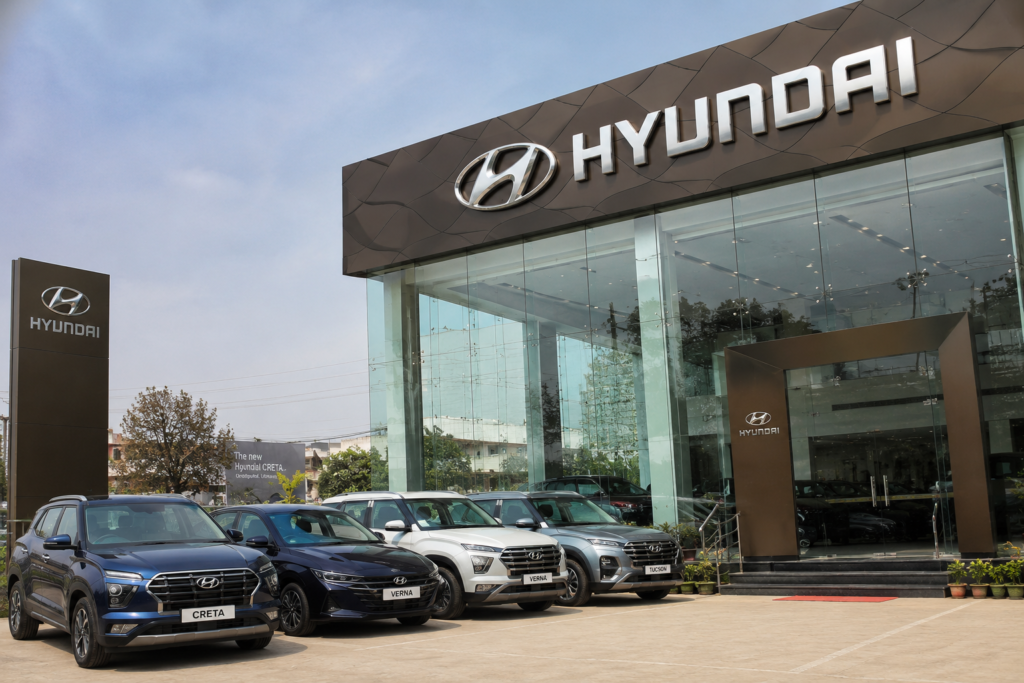
The company operates a massive manufacturing plant near Chennai, one of the largest single-location passenger vehicle plants in India. As of March 2024, HMIL had sold nearly 12 million passenger vehicles in India and through exports. Its lineup of 13 models includes the Creta (its biggest revenue driver), Venue, i20, Verna, Alcazar, Tucson, and the all-electric Ioniq 5.
With 1,366 sales points and 1,550 service points across India, Hyundai’s distribution network is among the deepest in the country’s auto sector.
Source: Hyundai Motor India RHP; CRISIL Report; Chittorgarh.com
IPO Details: Price Band Rs 1,865-1,960, Full OFS Structure
Here’s the thing that raised eyebrows from the start. The entire Hyundai Motor India IPO was an offer for sale (OFS). That means the company itself received zero rupees from the offering. Every single share – all 14.22 crore of them – was sold by the parent, Hyundai Motor Company, South Korea.
The price band was set at Rs 1,865 to Rs 1,960 per share, with a face value of Rs 10. The minimum lot size was 7 shares, meaning retail investors needed Rs 13,720 to participate. The IPO opened on October 15, 2024, and closed on October 17, 2024. Allotment was finalized on October 18, with listing on both BSE and NSE on October 22, 2024.
Anchor investors committed Rs 8,315.28 crore on October 14, showing strong institutional interest. Kotak Mahindra Capital, Citigroup Global Markets India, JP Morgan India, and Morgan Stanley India served as book-running lead managers. Kfin Technologies was the registrar.
The category-wise allocation was 50% for QIBs, 35% for retail, and 15% for NIIs. There was also a reservation of 7,78,400 shares for employees at a discount of Rs 186 per share.
The pure OFS structure was a big talking point. When a company doesn’t receive IPO proceeds for growth, investors essentially fund the promoter’s exit. That framing didn’t sit well with many retail participants.
Source: Chittorgarh.com; 5Paisa; Business Standard (Oct 9, 2024)
GMP History: Pre-Listing Excitement and Expectations
The grey market premium journey for the Hyundai Motor India IPO was one of the most dramatic in recent IPO history.
When the price band was first announced on October 9, 2024, GMP shot up to around Rs 147 – suggesting a listing gain of roughly 7.5% over the issue price. Excitement was high. India’s biggest IPO 2024 was generating serious buzz, and grey market dealers were confident.
By October 14, the day anchor investors locked in, GMP had moderated to around Rs 35, pointing to a potential listing at Rs 2,025. Still a positive premium, but the enthusiasm was clearly fading.
Then came the subscription data, and things got ugly. Day 1 saw just 18% subscription. Day 2 ended at 42%. Retail investors barely participated – only 50% of the retail quota was filled by the final day. NIIs managed just 0.6 times. The overall subscription crossed the finish line at 2.37 times only because QIBs came in strong at 6.97 times on the last day.
By October 18, the day allotment was finalized, the GMP flipped negative. Shares were trading at a Rs 30 discount in the grey market. Two days before listing, on October 21, GMP bounced back to Rs 75 (3.83% premium) – but by then, nobody quite trusted the number.
Source: Business Standard (Oct 21, 2024); Outlook Business (Oct 18, 2024); EquityPandit
Listing Performance: Debuted at Rs 1,934 (Slight Discount)
October 22, 2024. Listing day for the biggest IPO India had ever seen. And it opened in the red.
Hyundai Motor India shares debuted at Rs 1,934 on the NSE, a 1.32% discount to the issue price of Rs 1,960. On the BSE, it was worse – Rs 1,931, a 1.47% discount. The stock touched an intraday high of Rs 1,968.80 but couldn’t sustain any momentum above the issue price.
For context, retail investors had subscribed to just 50% of their reserved quota. That’s the lowest retail participation among major IPOs in recent memory. NIIs were similarly cold at 0.6 times. Only QIBs showed real conviction, and even they couldn’t prevent a below-par listing.
The post-listing slide continued. Within 10 trading days, the stock was at Rs 1,814. By its 52-week low in April 2025, shares had dropped all the way to Rs 1,542.95 – a 21% decline from the issue price. For early investors, this was a painful stretch.
Source: Business Standard (Oct 22, 2024); 5Paisa (Nov 4, 2024); Kotak Neo
Current Share Price: June 2026 Update
Fast forward to June 2026, and the picture looks quite different from the listing-day despair.
As of early June 2026, the Hyundai Motor India share price hovers around Rs 1,870-1,930 range on NSE. The 52-week high stands at Rs 2,890 (reached around September 2025, when Hyundai signed a long-term wage settlement and export growth was strong). The 52-week low was Rs 1,658.
The stock hit its all-time high of Rs 2,890 in September 2025, representing a 47% gain over the issue price. At that point, the IPO looked like a massive success for patient investors. But the subsequent correction – driven by rising input costs, competitive pressure from Mahindra and Tata Motors, and broader market weakness – has pulled the share price back.
At current levels near Rs 1,880-1,930, the stock trades roughly at par with its IPO issue price of Rs 1,960. The P/E ratio sits around 28-29, and the P/B ratio is approximately 7.6-8. The market cap is approximately Rs 1.53-1.57 lakh crore.
For those who bought at the 52-week low of Rs 1,658 and sold near the high of Rs 2,890, the returns were exceptional. For those who held from IPO allotment, it’s been a rollercoaster that’s currently near breakeven.
Track Hyundai India Live Price
Source: Tickertape (HYUNDAI); Dhan; Kotak Neo; Screener.in
Why Did It List Below Issue Price? – Deep Analysis
This is the question that puzzled many investors. India’s second-largest car company, backed by a global auto giant, and it couldn’t even manage a green opening? Here’s what went wrong.
Pure OFS structure. Every rupee raised went to the South Korean parent, not to Hyundai India. Investors had no growth-capital story to buy into. This was a promoter monetization event, and retail investors saw through it.
Massive issue size. At Rs 27,870 crore, the supply of shares simply overwhelmed demand. Large IPOs struggle to generate the kind of scarcity premium that drives listing pops. When supply is unlimited relative to retail appetite, discounts follow.
Rich valuation at IPO. The issue was priced at a P/E multiple that many analysts considered stretched for an auto company facing cyclical headwinds. The domestic passenger vehicle market was showing signs of slowing demand in H2 2024, and inventory levels across the industry were elevated.
Retail disinterest. Only 50% retail subscription tells you everything. Individual investors voted with their wallets. The Rs 1,960 price tag for a single share, combined with the OFS-only structure, deterred many who might have otherwise applied.
Sector headwinds. The auto sector was battling multiple challenges – slowing urban demand, rising competition in the SUV segment (especially from Mahindra), and uncertainty around the EV transition timeline.
FII selling pressure. Broader foreign institutional investor outflows from Indian markets in October 2024 didn’t help sentiment around a large, foreign-promoter-led IPO.
Source: Business Standard; Swastika Investmart analysis; Mehta Equities research
Financial Analysis: Revenue, India Market Share, EV Plans
Let’s talk numbers, because the business underneath the stock price is actually solid.
For FY26, Hyundai Motor India reported revenue from operations of Rs 69,391 crore, up 2.13% from Rs 67,942 crore in FY25. Not explosive growth, but steady for a mature auto player. Net profit for FY26 came in at Rs 5,432 crore, down 3.7% from Rs 5,640 crore in FY25. The profit dip was primarily driven by rising input costs, higher commodity prices, and competitive pricing pressure.
Q4 FY26 showed some strain. Net profit fell 22% year-on-year to Rs 1,256 crore, while sales rose 5.2% to Rs 18,438 crore. The operating profit margin compressed to 14.45% in Q4, down from prior quarters. The board recommended a final dividend of Rs 21 per share (210% on face value) – a generous payout.
On the market share front, Hyundai faced a significant shift in FY26. Domestic sales declined 2.3% year-on-year to 584,906 units. More importantly, Mahindra and Tata Motors overtook Hyundai in sales rankings, pushing it to the fourth position for the first time in over two decades. The Creta continues to dominate the mid-size SUV segment with over 30% market share, but the overall brand is losing ground in a rapidly changing market.
The EV roadmap is where things get interesting. Hyundai launched the Creta Electric at the Bharat Mobility Global Expo 2025 and is targeting a 20% share of India’s EV market in the medium-to-long term. The company has committed $2.4 billion for EV development in India over eight years. Two new nameplates are planned for FY27 – a localised compact EV and a new ICE SUV. Hyundai also acquired the Talegaon manufacturing plant in Maharashtra for additional production capacity.
Source: Tickertape; Business Standard (Q4 FY25, Q4 FY26 results); BusinessToday (May 2026); Screener.in
Long-Term Outlook: Is Hyundai India a Good Investment?
The bull and bear cases here are both compelling, which is exactly what makes this stock interesting to watch.
On the positive side, Hyundai Motor India remains one of India’s strongest auto brands. The SUV portfolio (Creta, Venue, Alcazar, Tucson) is well-positioned in the fastest-growing segments. The EV push – backed by $2.4 billion in investment and global R&D capabilities – gives Hyundai a credible electrification story. The Talegaon plant acquisition adds manufacturing headroom for future volume growth. And the Rs 21 per share dividend signals the company’s cash generation capability.
JPMorgan maintains an “Overweight” rating with a target price of Rs 2,135, citing strong domestic demand drivers and export growth potential. Citi Research initiated coverage with a “Buy” rating and target of Rs 2,250, highlighting Hyundai’s strong parentage and premiumisation strategy.
The concerns are real too. Market share erosion is hard to ignore – dropping from second to fourth place in domestic sales within two years is a warning sign. Domestic sales declining 2.3% in FY26 while competitors grew suggests the product portfolio needs refreshment beyond Creta. The FY26 profit decline of 3.7% shows margin pressure isn’t temporary. And at a P/E of 28-29, the stock isn’t cheap for a company delivering low single-digit revenue growth.
The competitive landscape is fierce. Maruti Suzuki dominates volume. Tata Motors leads in EVs. Mahindra is winning the SUV battle. Hyundai needs its FY27 product launches to land successfully if it wants to reclaim ground.
Source: JPMorgan research (May 2026); Citi Research (Jan 2025); BusinessToday (May 2026)
Investor Verdict
This is not investment advice. Here’s a balanced look at the situation as it stands.
If you held from IPO allotment, you’ve been through a wild ride – a 21% drawdown to Rs 1,542, a 47% rally to Rs 2,890, and a correction back to around Rs 1,880-1,930. At current levels, you’re roughly at breakeven versus the issue price. The dividend income (Rs 21 per share in FY26 alone) provides some cushion.
For new investors considering entry, the key question is whether Hyundai’s FY27 product launches (compact EV, new SUV nameplate) can reignite volume growth and halt the market share slide. If they do, the stock could revisit its Rs 2,500+ levels. If they don’t, the P/E multiple may face further compression.
The Hyundai Motor India story is ultimately about patience. The brand, distribution network, manufacturing capability, and EV roadmap are all strong. The execution over the next 12-18 months will determine whether this stock rewards long-term holders or remains a sideways consolidation play.
Most brokerage targets cluster around Rs 2,100-2,250, suggesting 10-20% upside from current levels. That’s not a screaming buy, but it’s a reasonable risk-reward for investors with a 2-3 year horizon.
Source: JPMorgan; Citi Research; HDFC Securities
Last updated: June 2026
