


The Bajaj Housing Finance IPO was supposed to be the kind of story that makes retail investors feel like geniuses. A ₹70 stock that opens at ₹150, hits ₹188 within two days, and makes headlines on every financial news channel in the country. And for a brief moment in September 2024, it was exactly that.
But nine months later, the Bajaj Housing Finance share price today tells a very different story. From that euphoric all time high of ₹188.50, the stock has corrected to the ₹80 to 90 range, sitting well below its listing price and forcing many investors to ask: was it the company that was overvalued, or was it just the hype?
Let’s go through the entire journey, from the business model to the IPO, the GMP frenzy, the listing day fireworks, and where the stock stands now.
Bajaj Housing Finance: Company Overview and Business Model
Bajaj Housing Finance Limited was originally incorporated as Bajaj Financial Solutions Limited in Pune, Maharashtra in 2008. The company changed its name to Bajaj Housing Finance in 2014 and registered with the National Housing Bank (NHB) as a non deposit taking Housing Finance Company in September 2015. It started offering mortgage loans from FY2018 onward.
The company is a subsidiary of Bajaj Finance Limited, which itself sits under the Bajaj Finserv umbrella. That parentage matters because it gives the company access to something most standalone HFCs struggle with: a pre qualified customer base. According to Business Standard, about 40% of Bajaj Housing Finance’s home loans are sourced from Bajaj Finance’s existing customers. That’s a meaningful distribution advantage.
In terms of products, the portfolio is fairly diversified. Home loans form the core, accounting for roughly 54% of AUM as of March 2026. Lease rental discounting (LRD) contributes about 22%, loan against property (LAP) around 11%, and developer finance makes up approximately 12%.
As of March 2026, the company operates across 215+ branches in 174 locations spanning 20 states. The RBI has classified it as an “Upper Layer” NBFC under its scale based regulations, which is what triggered the need for a public listing in the first place. More on that in a moment.
IPO Details: Price Band ₹66 to ₹70, Issue Size ₹6,560 Crore

The Bajaj Housing Finance IPO opened for subscription on September 9, 2024 and closed on September 11, 2024. The price band was set at ₹66 to ₹70 per share with a face value of ₹10 per share. The lot size was 214 shares, putting the minimum retail investment at ₹14,980.
The total issue size was ₹6,560 crore, split between a fresh issue of ₹3,560 crore (roughly 50.86 crore shares) and an offer for sale of ₹3,000 crore by the promoter, Bajaj Finance. There was also a ₹500 crore reservation for shareholders of Bajaj Finance and Bajaj Finserv, plus a ₹200 crore employee reservation.
Here’s an important detail that often gets overlooked: this IPO wasn’t driven by a grand growth ambition. It was driven by compliance. The RBI mandates that Upper Layer NBFCs must be listed on stock exchanges by September 2025. Bajaj Housing Finance had to go public whether it wanted to or not.
The book running lead managers included Kotak Mahindra Capital, Bank of America Securities, Axis Capital, Goldman Sachs India, SBI Capital Markets, JM Financial, and IIFL Securities. KFin Technologies handled the registrar duties. The listing was scheduled on both BSE and NSE.
At the upper end of the price band, the company was valued at approximately ₹58,300 crore on a post diluted basis, which translated to a price to book ratio of about 3.2x.
Sources: Business Standard anchor investor report (September 6, 2024); Chittorgarh.com IPO details; m.Stock IPO page.
Subscription Status: Subscribed 64x, Record Breaking Demand
The numbers here are staggering, and worth breaking down properly.
On Day 1 (September 9), the IPO was already fully subscribed at 2.01x, which is almost unheard of for an issue of this size. Non Institutional Investors led the charge at 4.35x, followed by retail at 1.50x and QIBs at 1.07x.
By Day 2, overall subscription had jumped to 7.50x, with NIIs at 16.45x and QIBs at 7.46x.
By the close on Day 3 (September 11), the final subscription figures were remarkable. The overall IPO was subscribed approximately 63.6x to 67.4x depending on the data source. QIBs subscribed a jaw dropping 209x to 222x. NIIs came in at 41.5x to 44x. Retail was at 7x to 7.4x. The shareholder category saw 2.9x subscription.
Total bids exceeded ₹3.2 lakh crore for a ₹6,560 crore issue. The IPO attracted nearly 9 million applications, surpassing the previous record held by Tata Technologies at 7.35 million.
Before the IPO even opened, the company had raised ₹1,758 crore from 104 anchor investors, including the Government of Singapore, HDFC Mutual Fund, New World Fund, and Capital Group.
To put the 64x subscription in context: for every 64 people who applied, roughly 1 got an allotment. If you were a retail investor who got shares, you were genuinely lucky.
Sources: NSE subscription data; Business Standard Day 1, Day 2, and Day 3 coverage; m.Stock IPO subscription page.
GMP History: The Pre Listing Grey Market Premium Journey
The Bajaj Housing Finance IPO GMP was one of the most watched numbers during the subscription period. Grey market premiums started building well before the issue opened, and they climbed steadily as subscription data came in.
By Day 2 of subscription, Business Standard reported that shares were quoting at a grey market premium of ₹64, which represented a roughly 91% premium over the ₹70 issue price. Given that the IPO was already heavily oversubscribed at that point, the GMP kept climbing.
By the final day, estimates suggested the GMP had crossed ₹80 to ₹85 per share, implying an expected listing price in the ₹150 to ₹155 range. As it turned out, the grey market was remarkably accurate this time.
One thing to keep in mind: GMP is an unofficial, unregulated market. There’s no SEBI oversight, and prices are based entirely on speculative demand between informal dealers. It happened to be right for Bajaj Housing Finance, but that doesn’t make it a reliable tool. It’s useful as a sentiment gauge, not as investment advice.
Listing Day Performance: More Than Doubled on Day 1
September 16, 2024. That was the day Bajaj Housing Finance made its stock market debut, and what a debut it was.
The stock listed at ₹150 on both BSE and NSE, a premium of 114.29% over the issue price of ₹70. Within the first hour of trading, it hit a high of ₹160.92 on the BSE. By the close of the trading session, the share price settled at ₹165, giving investors who got allotment at ₹70 a staggering 135.7% return in a single day.
For someone who invested the minimum lot of 214 shares at ₹14,980, their holding was worth approximately ₹35,310 at the closing price. That’s a gain of over ₹20,000 in one day. Not a bad Monday.
The next day, September 17, the stock hit the 10% upper circuit at ₹181.48. By September 18, it touched its all time high of ₹188.50. In the first three trading sessions, investors who held from listing had seen their ₹70 investment rise by 169%.
The market cap at peak was north of ₹1.5 lakh crore, making Bajaj Housing Finance briefly one of the most valuable housing finance companies on Indian exchanges.
Sources: Business Standard listing day coverage; Upstox market data; TradingView BAJAJHFL chart.
Bajaj Housing Finance Share Price Today and Post Listing Decline Analysis
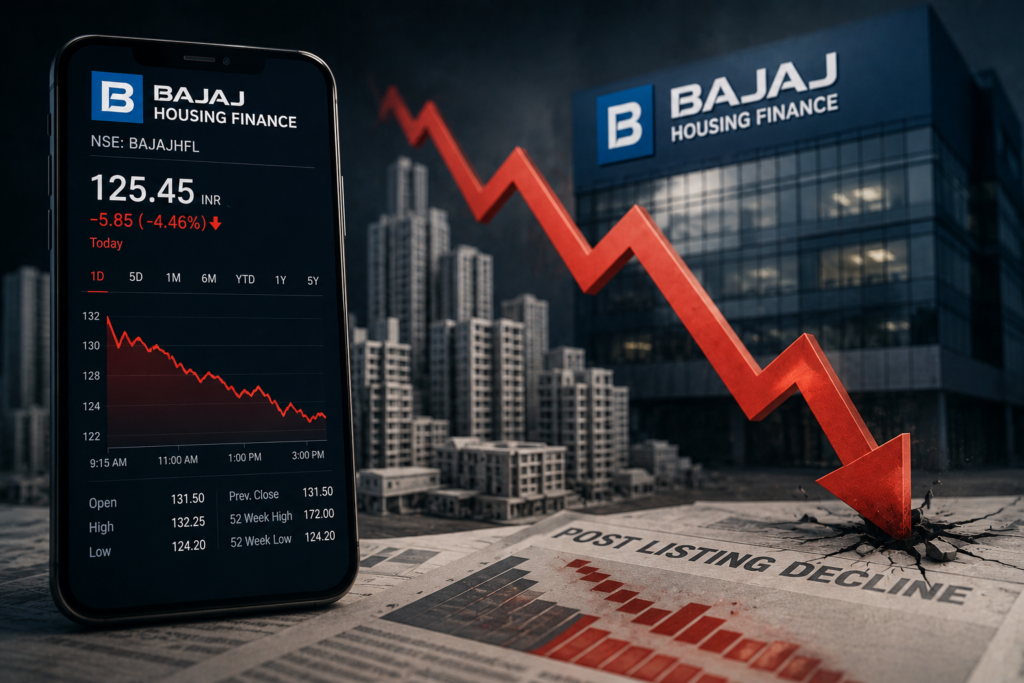
Here’s where the story gets less exciting. After touching ₹188.50 within days of listing, the stock began a slow and steady decline that has continued well into 2026.
The first major selloff trigger was the anchor investor lock in expiry in December 2024, three months after listing. On that day, shares dropped about 6%, and the stock was trading around ₹133 to ₹141. From its listing day high, that was already a 25%+ correction.
By early 2026, the decline continued. The 52 week high sits at around ₹128 and the 52 week low hit ₹72.65 in March 2026, meaning the stock actually fell below its IPO issue price of ₹70 in intraday trading before recovering.
As of late May 2026, the Bajaj Housing Finance share price today is in the ₹83 to ₹91 range, depending on the trading day. That’s roughly 55% below its all time high and about 18% above the issue price. The market cap has shrunk from over ₹1.5 lakh crore at peak to approximately ₹69,000 to ₹76,000 crore.
Several factors have contributed to this decline. The broader market correction starting late 2024 hit high valuation stocks particularly hard. The anchor lock in expiry added selling pressure. And perhaps most importantly, at ₹188, the stock was trading at over 10x book value for a housing finance company, which was always going to be unsustainable.
The current PE ratio is around 27 to 30x and the price to book ratio has come down to about 3.0 to 3.1x, which is more reasonable for an HFC of this quality, though still at a premium to most peers.
Sources: ICICIdirect share price data; Bajaj Broking share price page; TradingView historical chart; Business Standard anchor lock in coverage.
Financial Analysis: Revenue, PAT, NPA Ratios
The fundamentals of Bajaj Housing Finance remain solid, which is what makes the stock’s post listing decline more about valuation correction than business deterioration.
FY26 Full Year Performance (latest available): According to Screener.in and Business Standard’s Q4 FY26 results coverage, the company reported total revenue of approximately ₹11,147 crore for FY26. Net profit for the full year came in at ₹2,560 crore. Net interest income for FY26 grew 25% YoY to ₹3,752 crore. The AUM expanded 23% to ₹1,40,706 crore as of March 31, 2026.
Q4 FY26 Quarterly Snapshot: Net profit stood at ₹669 crore, up 14% YoY (or 20% on a normalised basis, excluding a one time ₹34 crore tax benefit in Q4 FY25). NII grew 15% to ₹945 crore. Pre provisioning operating profit rose 23% to ₹921 crore.
Asset Quality: This is where Bajaj Housing Finance truly stands out. The Gross NPA ratio was just 0.27% as of March 2026, improved from 0.29% a year earlier. Net NPA held steady at 0.11%. These are among the lowest NPA ratios in the entire housing finance sector. Around 75.5% of the company’s home loan AUM comes from customers with a CIBIL score above 750, which explains the portfolio quality.
Capital Adequacy: The capital adequacy ratio stood at 27.86% as of December 2024, well above regulatory requirements. The IPO proceeds of ₹3,560 crore have strengthened the capital base significantly.
Cost Efficiency: The cost of funds dropped 60 basis points to 7.3% in FY26. The operating expense to net total income ratio improved to 19.7% from 20.9% in FY25.
AUM Breakdown by Segment (March 2026): Home loans account for ₹76,055 crore (18% growth). LRD contributed ₹31,531 crore (44% growth, the fastest growing segment). LAP stood at ₹15,191 crore (24% growth). Developer finance came in at ₹16,226 crore (13% growth).
The business is clearly performing well. AUM growth of 23%, profit growth of 20%+ on a normalised basis, and NPA ratios that would make most banks envious. The issue was never the business. It was the price the market was willing to pay for it at listing.
Sources: Business Standard Q4 FY26 results; Screener.in financial summary; Investywise FY26 analysis; Groww financial data.
Should You Have Applied? The Investor Verdict
Let’s be honest about this one. The answer depends entirely on what you did after getting allotment.
If you got shares at ₹70 and sold on listing day or within the first week, this was one of the most profitable IPOs of 2024. A ₹14,980 investment turned into ₹32,000 to ₹40,000 depending on when exactly you exited. That’s a 115% to 170% return in under a week. Hard to argue with those numbers.
If you held on, hoping for continued momentum or treating it as a long term bet, the picture is different. The stock is currently trading around ₹83 to ₹91. That’s still a modest 18 to 30% return over the issue price, but it’s a painful 55% drawdown from the all time high. Anyone who bought on listing day at ₹150 or ₹165 is sitting on significant losses.
The broader lesson here isn’t unique to Bajaj Housing Finance. It applies to almost every mega IPO that lists at a massive premium: the listing day price already bakes in 2 to 3 years of future growth expectations. When you buy at 10x book value, you need everything to go perfectly just to justify the price. And markets rarely cooperate that neatly.
For current investors watching the stock at ₹83 to ₹91: The valuation is now far more reasonable at roughly 3x book value and 27x earnings. The business fundamentals are strong: 23% AUM growth, sub 0.3% GNPA, improving cost ratios, and a parent company (Bajaj Finance) that provides a genuine competitive moat. Whether this price represents good value depends on your investment horizon and risk tolerance.
This article is not investment advice. Consult a SEBI registered investment advisor before making any decisions.
Disclaimer: This article is for informational and educational purposes only and does not constitute investment advice. All financial data is sourced from Bajaj Housing Finance’s quarterly filings, Business Standard, Screener.in, Chittorgarh.com, and NSE/BSE official data. Please consult a SEBI registered investment advisor before making any investment decisions.
