

If you’ve been even loosely following the Indian stock market, you’ve heard the buzz. The Reliance Jio IPO is coming, and it’s shaping up to be the largest private-sector listing India has ever seen. We’re not talking about another hyped-up SME IPO that pops 90% on listing day and then quietly bleeds for six months. This is different.
Jio Platforms, the digital arm of Mukesh Ambani’s Reliance Industries, is preparing to go public with a valuation that analysts peg somewhere between $130 billion and $170 billion. At the upper end, that would make it bigger than Bharti Airtel’s entire market cap on day one.
So let’s break this down properly: the company, the numbers, the timeline, the valuation, and whether retail investors like you and me should actually care.
What Is Reliance Jio?: Company Background and History
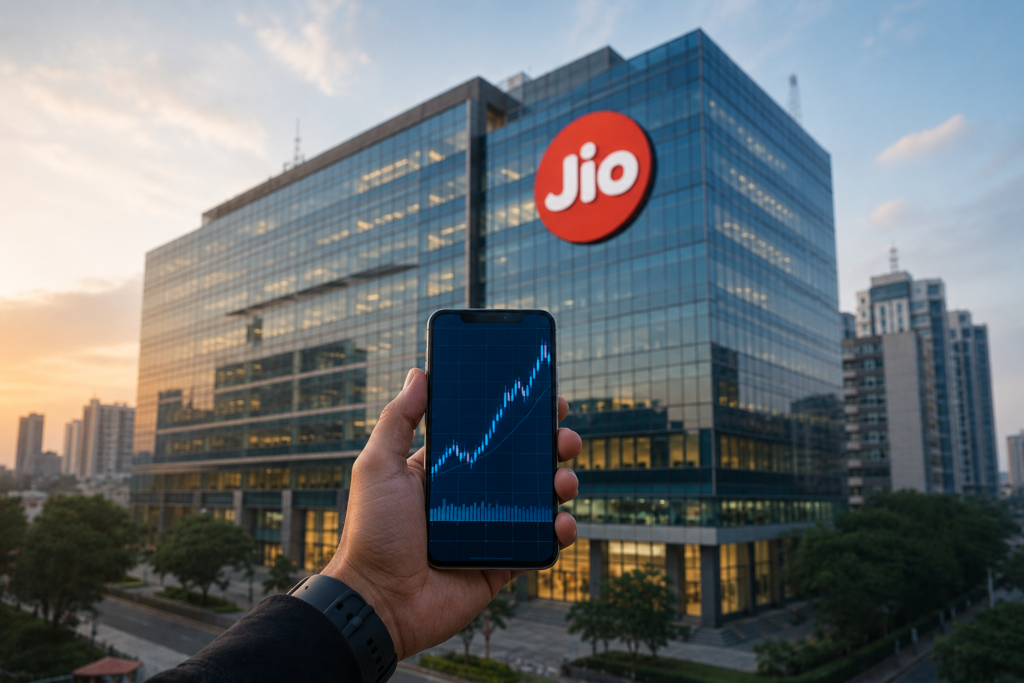
Reliance Jio Infocomm launched commercially in September 2016, and within months, it had turned the Indian telecom industry completely upside down. Free voice calls, the cheapest 4G data on the planet, and a network that worked surprisingly well for a newcomer. Jio didn’t just enter the market; it bulldozed the competition.
Companies like Aircel, RCom, and Tata Teleservices either shut down or merged. Vodafone and Idea were forced into a survival merger. Bharti Airtel had to completely rethink its pricing strategy. One company rewrote the rules for an entire industry.
Today, Jio Platforms sits as the umbrella entity for Reliance’s digital businesses. This includes the telecom arm (Reliance Jio Infocomm), the broadband service (JioFiber), and a wide suite of digital apps covering payments, streaming, gaming, and commerce. As of Q4 FY25, the company serves over 488 million subscribers, making it India’s largest telecom operator by a comfortable margin.
Between 2020 and 2021, Jio Platforms attracted investments from global heavyweights like Meta (then Facebook), Google, Silver Lake, KKR, and Abu Dhabi’s Mubadala. That fundraising round alone pulled in over ₹1.5 lakh crore and valued the platform at roughly $65 billion. The IPO valuation being discussed now is more than double that figure.
Jio IPO Date 2026: Key Dates and Timeline (Latest Updates)
Here’s where things get a bit frustrating. Mukesh Ambani publicly stated at Reliance Industries’ 48th Annual General Meeting that the company is targeting a Jio Platforms listing in the first half of calendar year 2026. That was the signal the market was waiting for.
But as of June 2026, the Draft Red Herring Prospectus (DRHP) has still not been filed with SEBI. Reports from multiple sources, including m.Stock and EQMint, suggest the DRHP filing has been pushed to H2 2026, with the actual IPO opening possibly slipping into late 2026 or early FY28.
Why the delay? Two reasons stand out.
First, there’s a regulatory piece. SEBI approved amendments to the Securities Contracts (Regulation) Rules in September 2025. These changes introduced a tiered, scale-based approach to minimum public offer requirements. For mega-cap companies valued above ₹5 lakh crore, the minimum dilution dropped to just 2.5%. Before this change, Jio would have needed to dilute at least 5%. At its expected valuation, this would mean flooding the market with over ₹70,000 crore worth of shares. The new rule makes a smaller, more controlled offering possible.
Second, Reliance is reportedly restructuring certain inter-company arrangements to present cleaner standalone financials in the DRHP. When your IPO is going to be dissected by every analyst on the planet, you want your books to tell a clear story.
Based on available reports, here’s the tentative timeline:
The DRHP filing is expected by mid to late 2026. Once filed, SEBI typically takes 30 to 75 days for approval. The IPO open date could fall in late 2026 or early 2027, with listing on both NSE and BSE.
Nothing is confirmed yet. If you want to track this in real time, keep an eye on SEBI’s draft offer documents page.
Jio IPO Price Band and Valuation: What the Numbers Say
Let’s talk money. The Reliance Jio IPO valuation is the single most debated number in Indian finance right now, and for good reason.
Analyst estimates currently range from $100 billion on the conservative end to $170 billion at the top. Morgan Stanley, Goldman Sachs, and Kotak Mahindra Capital, all reportedly involved in the deal, have worked with a broad band of ₹10.8 to ₹14.1 lakh crore.
At a $130 billion valuation with a 2.5-3% dilution, the issue could raise approximately ₹33,000 to ₹38,000 crore. Some estimates from sources like Finnpick put the total issue size even higher, at ₹50,000 to ₹52,500 crore if the dilution edges toward 3%.
As for the actual price per share, analyst estimates from EQMint suggest a retail price range of ₹1,048 to ₹1,457 per share at the $130-$170 billion band. Other estimates from IPOMarket.in place it at a broader ₹200-500 range depending on the final valuation and equity structure. The actual price band will only become clear once the DRHP is filed.
One thing worth mentioning: Reliance has reportedly signalled a 15-20% retail discount, similar to what we saw with LIC’s IPO. If that holds, the effective entry price for retail investors could be meaningfully lower than the upper band.
Here’s a quick comparison to put the valuation in context:
| Company | Approx. Market Cap | | | | | Reliance Industries (Parent) | ~₹18 lakh crore | | Bharti Airtel | ~₹9.5 lakh crore | | Jio Platforms (Expected IPO) | ₹10.8 to ₹14.1 lakh crore |
At the upper end of its expected range, Jio would list as the second or third most valuable company in India. Let that sink in.
Jio Financials: Revenue, Profit, and Growth Trajectory
Numbers don’t lie, and Jio’s numbers are genuinely impressive. According to Reliance Industries’ Q4 FY25 earnings presentation, here’s how Jio Platforms performed:
FY25 (Full Year, Jio Platforms Consolidated): Gross revenue came in at ₹1,50,270 crore, up roughly 17% YoY. Operating revenue stood at ₹1,28,218 crore. EBITDA hit ₹64,170 crore with a margin of approximately 50%. And net profit (PAT) reached ₹26,120 crore, growing about 22% YoY.
Q4 FY25 Highlights: Revenue from operations reached ₹33,986 crore, up 17.7% YoY. EBITDA grew 18.5% YoY to ₹17,016 crore. PAT jumped 25.8% YoY to ₹7,023 crore. ARPU climbed to ₹206.2 per month from ₹181.7 in Q4 FY24. And the total subscriber base stood at 488.2 million.
The standout metric here is ARPU growth. At ₹206.2, Jio’s average revenue per user has climbed 13.5% year-on-year, driven largely by tariff hikes implemented in mid-2024 and an improving subscriber mix as JioFiber and 5G users contribute more.
That EBITDA margin of approximately 50% is remarkable for a telecom business. Most global peers operate in the 30-40% range. This kind of margin tells you two things. Jio’s scale is massive enough to absorb fixed costs comfortably, and its digital services ecosystem adds revenue layers that pure-play telecom operators don’t have.
For comparison, Jio Platforms’ FY24 numbers showed operating revenue of ₹1,09,558 crore and net profit of ₹21,434 crore. That’s a healthy jump in just one year.
Sources: Reliance Industries Q4 FY25 Analyst Presentation (April 25, 2025); Inc42 FY25 earnings coverage; Communications Today Q4 FY25 report.
Why Is Jio IPO Potentially India’s Biggest Ever?
Let’s count the reasons, because there are several.
Scale that’s hard to replicate. Over 488 million subscribers. The world’s fastest 5G rollout, with more than 230 million users already on 5G. JioFiber expanding into millions of homes. No other Indian company, telecom or otherwise, operates at this scale in the digital services space.
The regulatory tailwind. SEBI’s September 2025 amendments to minimum public offer norms were practically tailor-made for companies like Jio. The ability to list with just 2.5% dilution and take up to 10 years to reach 25% public shareholding means Reliance can control the supply of shares carefully. Less dilution at listing generally means tighter price discovery and potentially stronger listing performance.
A diversified revenue base. Jio isn’t just a SIM card company anymore. Jio Platforms houses digital commerce, payments (JioPay), streaming (JioCinema), cloud services, and enterprise connectivity solutions. The FY25 results specifically called out growth from the scaling of digital services platforms alongside the core telecom business.
Global investor appetite. The 2020 fundraise attracted Meta, Google, Intel Capital, Silver Lake, KKR, General Atlantic, TPG, and several sovereign wealth funds. Many of these investors are expected to seek partial exits through the IPO, which means global institutional demand will be built in from day one.
Ambani’s credibility. Say what you will about conglomerates, but Reliance has a track record of executing large, complex financial transactions. From Reliance Retail to Jio Financial Services, both successfully listed or structured, the group has demonstrated it knows how to bring an asset to market.
For context, the largest IPO in Indian history was LIC at roughly ₹21,000 crore. The Jio IPO could raise nearly double that amount.
Grey Market Premium (GMP) Expectations
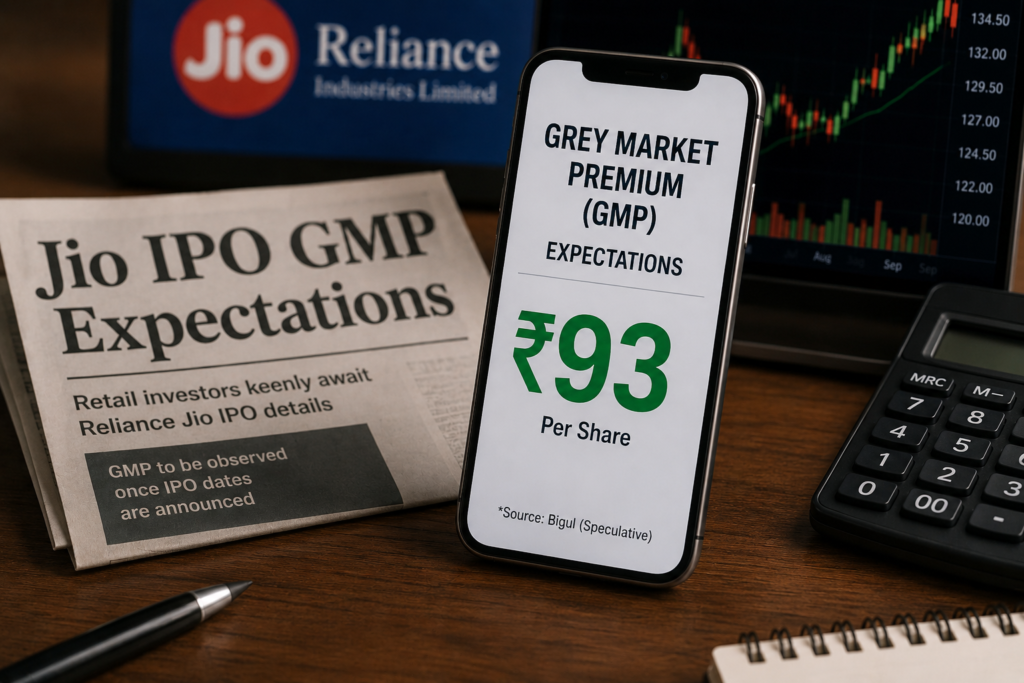
Let’s address the elephant in the room. Everyone wants to know the Jio IPO GMP, and the honest answer is: there isn’t one yet.
Since the DRHP hasn’t been filed, there’s no active grey market trading for Jio shares. GMP data will only begin appearing once the IPO dates are formally announced and unofficial market makers start quoting prices.
That said, one source (Bigul) mentioned an early speculative GMP of around ₹93 per share, though this should be taken with a massive grain of salt. Pre-DRHP GMP figures are often unreliable and based more on sentiment than substance.
What we can say with reasonable confidence is this: given the brand recognition, the institutional interest, and the sheer size of the retail investor base that tracks anything Reliance does, oversubscription in the retail category is widely expected. High oversubscription typically pushes GMP higher as demand outstrips supply.
But here’s the reality check. GMP is an unofficial, unregulated market. It’s driven by speculation, not fundamentals. Using GMP as your primary decision-making tool for an investment of this scale would be like checking the weather forecast to decide whether to buy a house. It’s one data point, not the whole picture.
Should You Apply?: Investor Verdict
This is where I have to be careful, because this article isn’t investment advice. But I can lay out the factors that matter.
The case for applying: Jio Platforms is a profitable, high-growth business with a dominant market position, diversified revenue streams, and the backing of India’s largest conglomerate. Its financials show consistent double-digit growth in revenue, EBITDA, and profit. The ARPU trajectory is encouraging, and the expansion into broadband, enterprise, and digital services gives it multiple growth levers.
If there’s a retail discount of 15-20%, and if the valuation is set at the lower end of the expected range, the risk-reward profile looks reasonable for investors with a medium-to-long-term holding horizon.
The case for caution: At $170 billion, Jio would be priced at roughly 65x its FY25 net profit. That’s not cheap by any standard. Bharti Airtel, for reference, trades at a lower earnings multiple despite having a higher ARPU (around ₹245 vs Jio’s ₹206). Some analysts have pointed out that Airtel earns roughly ₹45 more per user per month, which calls into question whether the upper end of Jio’s valuation is justified.
There’s also the heavy capex story. Continuous investment in 5G infrastructure, satellite broadband, and AI-related services will consume significant capital. Jio’s free cash flow picture may look different from its profit picture once you account for these ongoing investments.
And finally, allotment odds. For a mega IPO like this, retail oversubscription could easily cross 10-15x, meaning your chances of getting allotment are slim unless you apply through multiple demat accounts (within the legal limits, of course).
Bottom line: Do your own research. Read the DRHP when it’s filed. Look at the actual price band, not the speculative one. And consult a SEBI-registered investment advisor before making a decision.
FAQ: Reliance Jio IPO 2026
When is the Reliance Jio IPO date?
The exact date hasn’t been announced. The DRHP is expected to be filed with SEBI by mid-to-late 2026, with the IPO likely opening in late 2026 or early 2027.
What is the expected Jio IPO price band?
Not officially announced. Analyst estimates range from ₹200-500 per share on the lower end to ₹1,048-1,457 per share at the higher valuation band ($130-170 billion).
What is the Jio IPO valuation?
Estimates from multiple banks and research houses place it between $100 billion and $170 billion (₹8.5 to ₹14.1 lakh crore approximately).
Is there a Jio IPO GMP available?
No official GMP exists yet since the DRHP hasn’t been filed. Early speculative figures are unreliable at this stage.
How can I apply for the Reliance Jio IPO?
Through any registered stockbroker or your bank’s demat/trading account (UPI-based ASBA process). You’ll need an active demat account linked to your PAN.
Will Reliance Industries shareholders get any benefit?
Reports suggest existing Reliance Industries shareholders may benefit from a shareholder quota during allotment, similar to past Reliance group listings.
What is Jio’s revenue and profit?
For FY25, Jio Platforms reported consolidated gross revenue of ₹1,50,270 crore and net profit of ₹26,120 crore, as per Reliance Industries’ official earnings presentation.
Disclaimer: This article is for informational and educational purposes only. It does not constitute investment advice. Please consult a SEBI-registered investment advisor before making any investment decisions. All financial data cited is sourced from Reliance Industries’ official filings, SEBI publications, and reputed financial news platforms including Inc42, Business Standard, m.Stock, and Communications Today.

1 thought on “Reliance Jio IPO: Everything You Need to Know Before You Hit Apply”